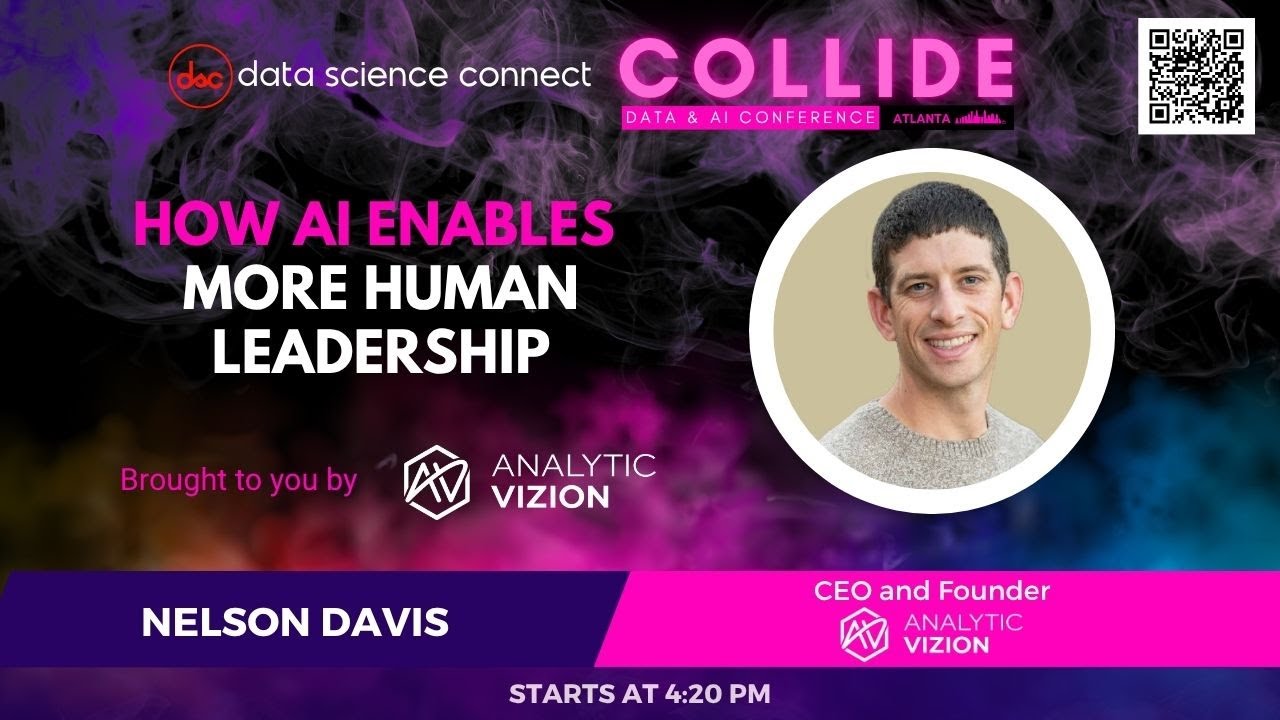
At COLLIDE 2025, Analytic Vizion CEO and founder Nelson Davis argued that AI will make leadership more human, not less. He outlined three keystone habits for data and analytics leaders and a simple matrix for deciding when AI should automate, augment or advise on a decision.
Key takeaways
- Decisions are the product. Davis said knowledge workers produce better decisions, and today's AI decisions may shape the next 200 years.
- EQ is rising as raw intelligence loses value. AI is good at amassing knowledge, so empathy, curiosity and clarity matter more.
- Three keystone habits: empathy and curiosity, relationship building and interdependence, and courageous agency.
- Match AI to uncertainty and stakes. Automate low-stakes, predictable work; keep humans making the final call when stakes and uncertainty are both high.
- What remains is human. Davis expects relationships, discernment, creation and vision to define work as machine-like tasks disappear.
The leaders sitting in today's data and AI teams may make decisions that shape the next 200 years, Nelson Davis, CEO and founder of Analytic Vizion, told attendees at COLLIDE Data + AI Conference 2025 in Atlanta. In a session sponsored by Analytic Vizion, Davis argued that AI's biggest effect on leadership will be to make it more human, and laid out three habits he believes the next generation of data and analytics leaders will need.
Davis pointed to the Industrial Revolution, about 200 years ago, when society moved from rural to urban and from agrarian to industrial, and modern capitalism took shape. Decisions made then still affect society and markets today, he said, and AI is powerful enough to carry the same weight. "Leaders make the future," he said, and they do it through their decisions.
Why does AI make human leadership more important?
People in data, technology and analytics do knowledge work, Davis said, and citing Shane Parrish's book Clear Thinking, he said the product of knowledge work is a better decision. Those decisions will reach well beyond any one organization, into communities and societies.
He argued that the value of raw intelligence is falling because AI is good at amassing knowledge and keeping up with new technology. Emotional intelligence, meanwhile, has never been more valuable. "If you've built your career or even more concerning your identity on being the smartest person in the room," he said, the value you provide will diminish over time. The shift he urged is toward humble curiosity, empathy and purpose-driven clarity.
What are the keystone habits of AI-enabled leaders?
Davis said his three habits are not an exhaustive list but a place to start.
Empathy and curiosity. Empathy means seeking first to understand, finding different perspectives and uncovering hidden impacts, Davis said. AI will let leaders bring more stakeholders to the table even when they aren't physically present, including people who don't speak the same language. Curiosity, he said, is an act of humility. With data multiplying, there is no shortage of information, only of the wisdom to see what matters. He said prompt engineering is not new: "We simply called them great question askers in the past."
Relationship building and interdependence. Teams that have always been all human will collaborate with AI as well, Davis said. AI may also give people access to coaching from thinkers they could never meet, by learning from the material those thinkers have published. Executives will be able to take strategy and personalize what it means for each role in an organization.
He added that leaders will increasingly look at systems as a whole rather than as linear chains of cause and effect. Their job will be to define clear and worthy outcomes and let AI optimize the individual processes.
Courageous agency. "We had better get comfortable with discomfort," Davis said. Research and intelligence gathering used to be expensive and slow, but AI can do market research in minutes, so leaders need to get to action faster, fail fast and learn quickly. He said some business models that don't work today may become profitable within months or a few years because of AI. Agency also means deciding deliberately where humans stay in the decision-making process, he said, which raises hard questions about who gets the blame when something goes wrong and who gets the credit when it succeeds.
When should leaders automate decisions with AI and when should humans decide?
Davis shared a two-by-two matrix that plots uncertainty against the stakes of a decision:
- Low uncertainty, low stakes: ripe for automation and rapid scaling, because mistakes are acceptable and outcomes are predictable.
- Higher uncertainty, low stakes: augmentation. His example was sales development reps, where AI listens for trigger questions during calls and surfaces the right material so the rep doesn't have to say "let me get back to you."
- Low uncertainty, high stakes: scenario planning and exploration, such as stress testing supply chain or financial systems.
- High uncertainty, high stakes: partnership with AI, with contextually aware humans "making the final call." This, he said, is where strategic leadership and goal setting live.
What is the long-term vision for AI and leadership?
Davis said some AI researchers fear they are building the end of humanity. He said he respects that view but chooses an optimistic one. "AI has no new ideas," he said. What the next chapter needs is distinctly human: a vision for how people and AI will work together toward good ends.
He predicted that tasks requiring people to act like machines will disappear and that professions built on being "libraries of knowledge" will fade. What remains, he said, will be "relationships, discernment, creation, and vision." He said he finds that outcome liberating.
Hear more leadership perspectives at COLLIDE 2027
COLLIDE, the largest AI conference in the Southern U.S., brings more than 1,000 enterprise data and AI leaders to Atlanta for a day of keynotes, panels and sessions on where AI is taking organizations and the people who lead them. The 2027 conference takes place Wednesday, October 13, 2027, at the Sandy Springs Performing Arts Center. See the COLLIDE event page for updates, with registration coming soon.
Frequently asked questions
How does AI change what makes a good leader?
Davis argued that as AI handles knowledge gathering, emotional intelligence, humble curiosity, empathy and purpose-driven clarity become a leader's most valuable traits.
When should AI automate a decision versus leave it to a human?
In the matrix Davis shared, low-uncertainty, low-stakes decisions suit automation, while high-uncertainty, high-stakes decisions call for AI partnership with a human making the final call.
What are keystone habits for AI-era leaders?
Davis named three: empathy and curiosity, relationship building and interdependence, and courageous agency.
Is prompt engineering a new skill?
Davis said no. People who asked great questions have always done it, and the person who asks the best question wins the day.
Watch: How AI Enables More Human Leadership, brought to you by Analytic Vizion on YouTube
Event: COLLIDE AI Conference · More coverage: COLLIDE AI Conference insights