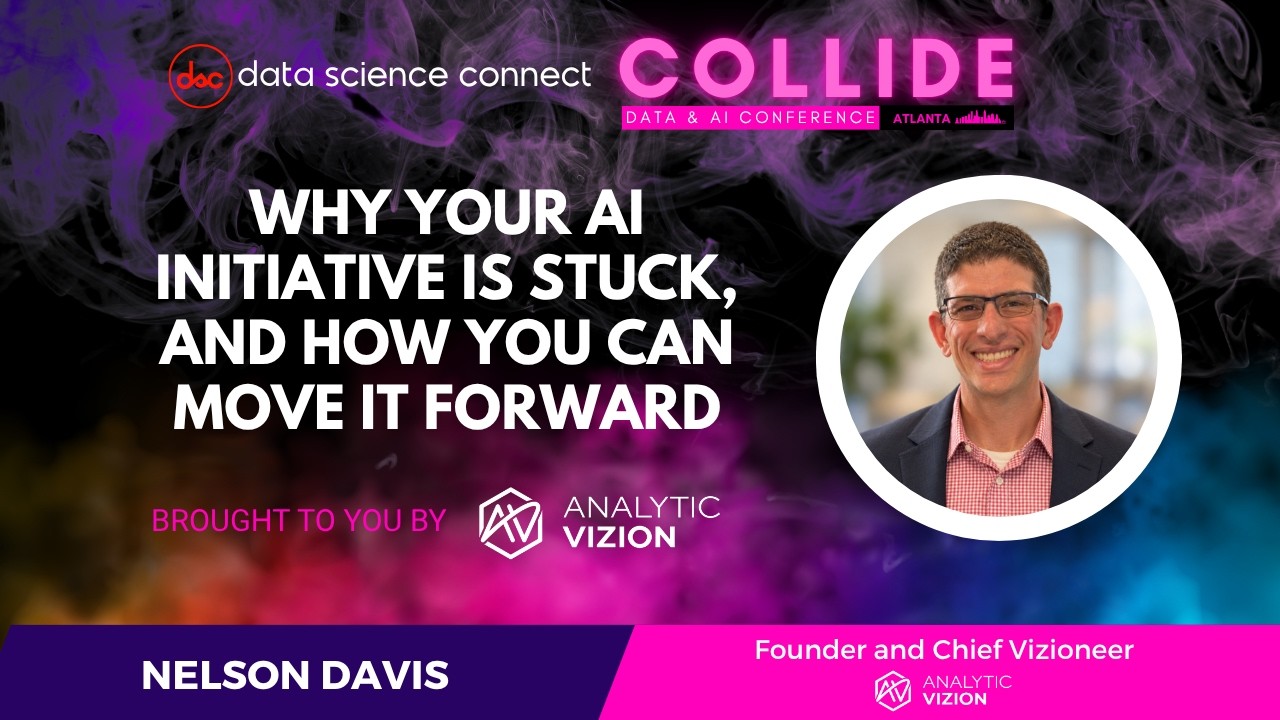
Stalled AI initiatives usually suffer from unclear goals and weak alignment, not weak technology, Analytic Vizion founder Nelson Davis told COLLIDE Data + AI Conference 2026. He laid out an impact-first planning sequence and five questions leaders can use to get their projects moving again.
Key takeaways
- Technology is rarely the bottleneck. Davis said AI just exposes existing gaps in clarity and alignment faster.
- Starting with the tool backfires. Teams that pick technology first keep discovering new requirements and lose momentum.
- Plan from impact down. Work through outcomes, decisions, moments, people and process before choosing technology.
- Trust drives speed. People need to trust the leader and believe the destination is worth reaching.
- Find the single constraint. Pair a north star with clarity on the one next step that unlocks progress.
When an enterprise AI initiative stalls, leaders tend to blame the model, the tools or the governance team. Nelson Davis, Founder and Chief Vizioneer at Analytic Vizion, told attendees at COLLIDE Data + AI Conference 2026 in Atlanta that the real problem is usually something older than AI: unclear goals and a lack of alignment.
"The technology isn't the bottleneck," Davis said in his session, "Why Your AI Initiative Is Stuck, and How You Can Move It Forward."
Why do AI initiatives get stuck in the middle?
Davis pointed to Kanter's Law, which he attributed to a Harvard professor writing on change management. Initiatives start with excitement and end with celebration, but "in the middle, everything feels like a failure," he said. The middle is where execution and alignment have to happen.
He illustrated it with the story of Peter, a capable data and analytics leader asked to roll out a global AI initiative. Peter started with the technology he already had and the use cases his own team could see. As he talked to more of the organization, the tool he had picked kept collecting new requirements. A project he expected to take weeks stretched into months, and by the time he heard from the full set of stakeholders, end users and customers, he realized his approach would not work.
Peter assumed he could imagine everything the organization needed, Davis said. That is an age-old problem, not a new one.
Is technology the bottleneck for enterprise AI?
AI accelerates everything, Davis argued, including how quickly organizations run into their existing weaknesses: a lack of clarity, missing alignment, and no shared view of the business impact. AI simply gets teams there faster.
The job of data, analytics and AI leaders, he said, is to help create better decisions. Better decisions sustained over time produce better outcomes and bigger impact. That requires a group of people deciding together and trusting one another. "Nothing moves faster than the speed of trust in business or in life," Davis said.
Trust works two ways, according to Davis: people have to trust the leader, and they have to believe the destination is worth their time and energy. "AI can help you go faster, but it can't help you choose the right destination," he said. That discernment, he added, remains the leader's responsibility.
How should leaders plan an AI initiative?
Davis described a top-down sequence that leaves technology for last:
- Impact: what the initiative is trying to do and why it matters
- Outcomes: what has to happen consistently. Like a jackhammer, he said, impact comes from hitting the same spot every time.
- Decisions: how people will decide collectively
- Moments: the specific points where decisions are made
- People: stakeholders, decision makers and end users
- Process: the integration layer between people and technology
- Technology
Because AI technology seems to change every three months, he said, teams that get the earlier layers right can swap in new tools and adjust a few processes without losing momentum.
He also cited Shane Parrish's book "Clear Thinking," which argues that every organization has to declare the one thing it values above everything else. When that value is shared, people can trust each other's decisions without double-checking each other's work, which speeds everything up, Davis said.
What questions help get an AI initiative unstuck?
Davis offered five:
- What must this initiative create? Leaders need to understand both the business need and what is possible.
- What decisions must people make differently? "If nothing changes, nothing changes," he said. Without specific decisions to improve, there is nothing to measure.
- Who must believe in and act on those decisions? That includes leaders and the people affected by the decisions.
- What do those people value, fear or need to trust? Davis urged leaders to get curious, stay out of judgment and listen with empathy, noting that fear is part of how people experience AI.
- What is the single constraint right now? Teams need a north star plus clarity on the next step.
Part of the difficulty is a change in identity, Davis said. People who created value by being the smartest person in the room now "have to become the most discerning person in the room."
The leader's job in AI transformation
Davis said the most important breakthrough is one organizations needed before AI and will need long after: a shared decision on where to go and why. "AI can accelerate the journey," he said. "It is the job of the leader to choose the destination and to bring the people with it."
Hear more AI leadership sessions at COLLIDE 2027
COLLIDE, the largest AI conference in the Southern U.S., brings more than 1,000 enterprise data and AI leaders to Atlanta. The 2027 conference takes place Wednesday, October 13, 2027, at the Sandy Springs Performing Arts Center. Senior leaders working through the same questions can also meet peers at Data Science Connect's invitation-only ALIGN AI Executive Summits, held in eight U.S. cities in 2027.
Frequently asked questions
Why do AI initiatives get stuck?
According to Davis, most stall because leaders start with the technology and their own team's use cases, missing stakeholders, decisions and requirements across the organization.
What is Kanter's Law?
A change-management principle Davis cited: initiatives start with excitement and end with celebration, but in the middle everything feels like a failure.
How should leaders plan an AI initiative?
Davis recommends starting with impact, then outcomes, decisions, the moments decisions are made, the people involved and process, leaving technology for last.
What questions help get an AI project unstuck?
Davis asks what the initiative must create, what decisions must change, who must act on them, what those people value, fear or need to trust, and what the single constraint is.
Watch: Why Your AI Initiative Is Stuck, and How You Can Move It Forward on YouTube
Event: COLLIDE AI Conference · More coverage: COLLIDE AI Conference insights