At The AI Enterprise Conference 2026, two Crum & Forster leaders explained how the 200-year-old insurer got 91% of its employees using AI, cut claims review from two hours to 15 minutes, and built governance that speeds projects up instead of slowing them down.
Key takeaways
- Adoption drives impact. 91% of Crum & Forster employees use Genie, its internal AI assistant, and average claims review time fell from 2 hours to 15 minutes.
- Leaders need a shared operating model. A two-day whiteboard session with every practice leader did more than months of weekly status meetings.
- Unified data makes agents useful. An earlier Snowflake investment let AI agents inherit permissions instead of constantly asking for them.
- Prototyping with users builds trust. Daily iteration with underwriters cut an 18-page AI report to five pages they could act on.
- Embedded guardrails speed delivery. Controls built into the platform mean new AI projects don't renegotiate approvals from scratch.
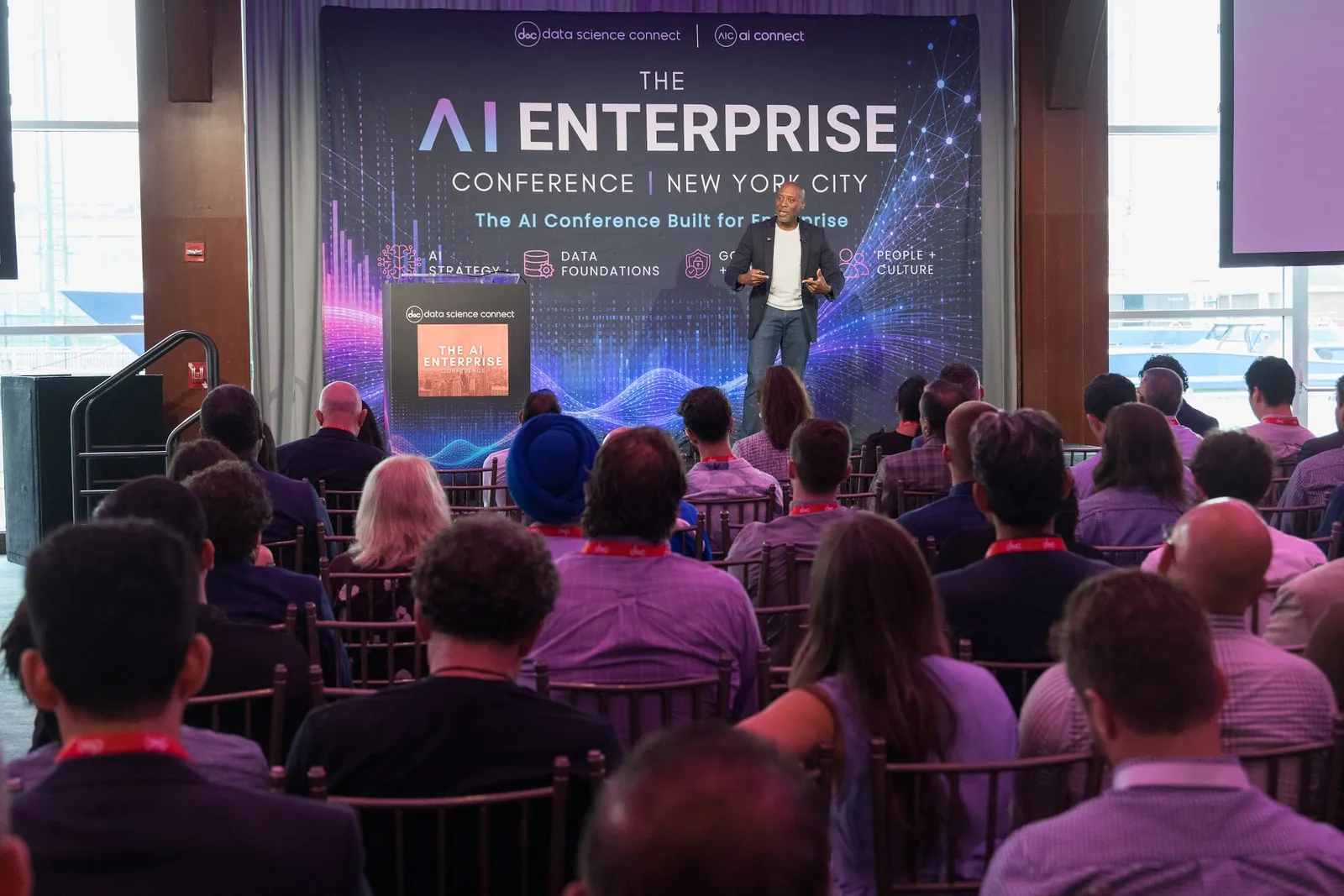
Commercial specialty insurer Crum & Forster has spent the past three years building, testing and scaling AI across the company. In an afternoon keynote at The AI Enterprise Conference 2026, held September 1 at Pier Sixty in New York City, Chief Risk Officer Jim Weiss and Kanchan Soman, VP of AI, Data & Analytics, laid out five lessons from that effort, "some the hard way," Soman said.
The talk focused less on whether AI works and more on what it takes to become what the pair called an "AI-forward" insurance company.
How did Crum & Forster drive enterprise-wide AI adoption?
Adoption came from two directions at once, Soman said. From the top, the CEO promoted AI tools in emails, forums and podcasts, and AI goals were added to performance reviews. From the bottom, employees started an AI study group, an AI guild and a video learning series, and entered a company-wide AI use-case contest.
The contest turned up more ways employees were using AI than any top-down assessment could have, according to Soman.
The results show up in the numbers. Ninety-one percent of employees now use Genie, the company's internal enterprise AI assistant. Claims review, one of the biggest wins, has dropped from an average of two hours to 15 minutes.
"Adoption without impact is activity," Soman said, adding that the two "compound each other."
Why AI transformation requires leadership alignment
Grassroots enthusiasm produced plenty of ideas but little early enterprise value, Weiss said. A biweekly meeting where practice leads compared use cases and vendors didn't solve it, because the way of working it aligned to kept going out of date.
So the company "got all our practice leaders in one room for two straight days with a whiteboard," Weiss said, calling it one of the lowest-tech investments of its AI transformation. The resulting operating model brought several changes:
- A larger project management office and enterprise architecture practice
- A shift in Weiss's predictive modeling team from building ML models toward MLOps, as coding agents cut model development from months to days or weeks
- An R&D team that now ships production work, not just prototypes
What data foundation do AI agents need?
Weiss described a familiar frustration: coding agents that keep stopping to ask permission. Crum & Forster's answer was a Snowflake platform first bought for financial reporting and compliance.
Because data, metadata, developers, foundation models and coding agents all lived in one governed environment, agents could inherit the permissions granted to them. That let the team build a semantic layer over its claims database and a digital twin of its operating model.
How rapid prototyping builds trust in AI
The first version of a property risk analysis agent produced an 18-page report. Underwriters called it too long, inconsistent and hard to act on, Soman said.
The team iterated with them daily. It added precise addresses for every location, structured outputs with a citation back to the source for every value, and flags on the accounts underwriters needed to focus on. The final output was a five-page package underwriters could make decisions from. Because they could inspect and challenge each version, they came to trust the tool.
How AI governance can speed up delivery
Crum & Forster uses three tiers of AI governance:
- Advisory: an AI council, a cyber steering committee and the AI guild
- Approval: cyber, legal and an architecture review board that sign off on everything before production
- Controls: an acceptable-use policy, an AI inventory aligned with the NIST AI Risk Management Framework, PII screening and role-based data access
The controls are built into the platform, so every new AI project inherits them, Soman said.
"Scale does not come from asking permission faster," she said. "Scale comes from reusable technology, governance and operating patterns."
Weiss closed with a line from a book by the company's CEO: "Chaos doesn't respect the old models." The best people to work through that chaos, he said, are a company's own people.
Hear more enterprise AI case studies in 2027
Sessions like this one, with Fortune 500 leaders sharing what worked and what didn't, are the core of The AI Enterprise Conference. The 2027 conference returns to Pier Sixty in New York City on Tuesday, August 31, 2027. Between conferences, Data Science Connect's free webinars bring enterprise AI leaders together online every month.
Frequently asked questions
What AI assistant does Crum & Forster use?
Crum & Forster built an internal enterprise AI assistant called Genie. 91% of its employees use it.
How much time did AI save in Crum & Forster's claims review?
Average claims review time fell from about two hours to 15 minutes.
What is an AI-forward insurance company?
As Crum & Forster's leaders described it, an insurer where AI is built into everyday workflows across the organization, supported by aligned leaders, unified data and governance built into its platforms.
What AI governance framework does Crum & Forster follow?
Its AI inventory is aligned with the NIST AI Risk Management Framework, within a three-tier governance model of advisory, approval and embedded controls.
Watch: Keynote: Five Learnings from C&F's Journey to Becoming an AI-Forward Insurance Company on YouTube
Event: The AI Enterprise Conference · More coverage: The AI Enterprise Conference insights