At The AI Enterprise Conference 2026, Reggie Townsend of SAS shared data from a 2,700-person survey showing trust in agentic AI trails generative AI by 10 points, and that 97% of people override AI recommendations. He argued governance is how enterprises scale human judgment.
Key takeaways
- Agentic AI faces a trust gap. Trust in generative AI sits at 76% versus 66% for agentic AI, according to SAS's survey with IDC.
- Overrides are the norm. 97% of respondents override AI recommendations at least sometimes, most often because they can't explain the answer.
- Trust and trustworthiness are diverging. AI systems became more trustworthy over the past year while confidence in them trended down.
- Governance scales judgment. Townsend argued governance automates human judgment so people aren't the organization's only guardrail.
- Five learnable behaviors set leaders apart: optimized data, continuous validation, organization-wide training, governance by default and early investment.
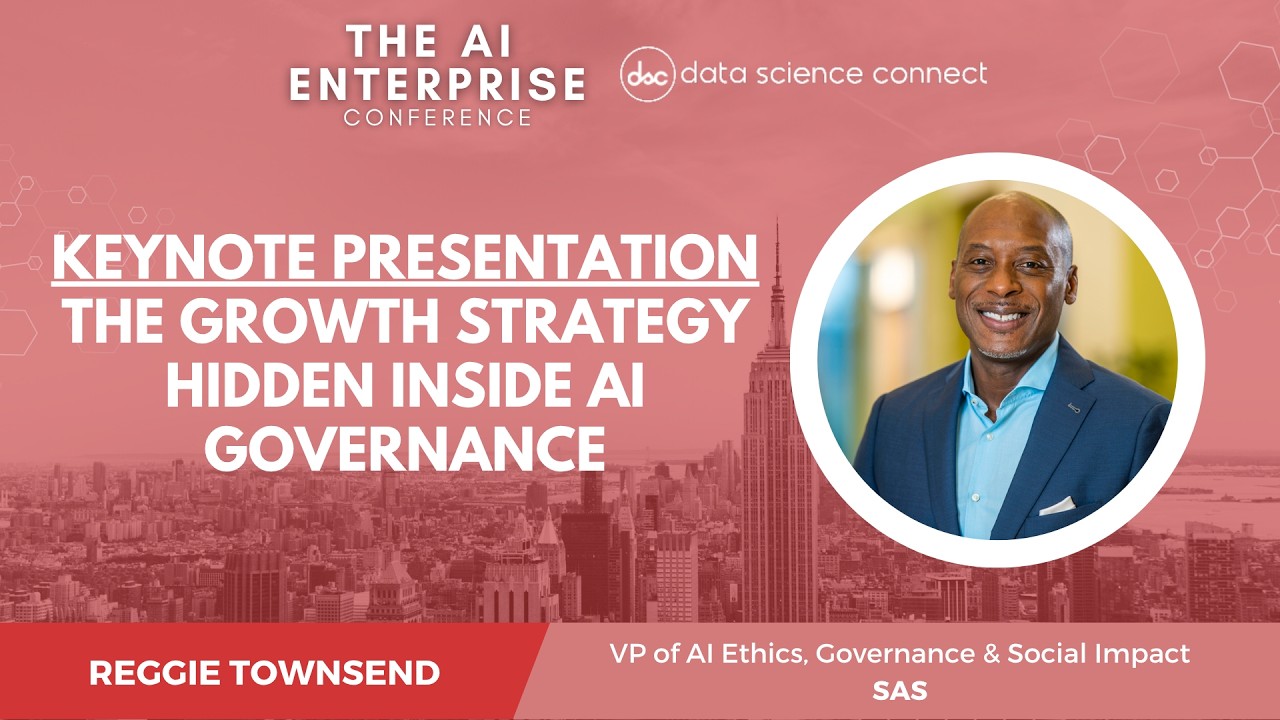
Enterprises want the best of AI without losing control over what matters most, and governance is how they get both, Reggie Townsend of SAS told a morning audience at The AI Enterprise Conference 2026 in New York City. In a keynote titled "The Growth Strategy Hidden Inside AI Governance," Townsend shared findings from SAS's second Data and AI Impact Report and argued that governance is "a system for scaling our judgment."
Townsend said he would alternate between hard data and leadership philosophy. His through line: governance is a mechanism for unlocking AI's promised benefits, not a brake on them.
What did the SAS Data and AI Impact Report measure?
SAS produces the report with research firm IDC, Townsend said. This edition surveyed 2,700 decision makers in 28 countries. The first edition measured what people believed about AI. This year's measured what they are actually doing with it.
Both editions found that trust and trustworthiness remain key to successful enterprise adoption, he said. Townsend drew a line between the two. Trust is how much confidence people have in AI. Trustworthiness is whether a system has actually earned that confidence. "Trust is a feeling. Trustworthiness is the evidence," he said.
Why do people trust agentic AI less than generative AI?
According to the survey, 89% of respondents say AI agents now play a role in decision-making, on a spectrum from informing a human to acting on their own. That is where the trust numbers start to split, Townsend said. Trust in generative AI sits at 76%, while trust in agentic AI sits at 66%.
The 10-point gap opens "the moment the AI goes from suggesting to actually doing something," he said. Earlier generative AI waited for a person to act. Agentic AI doesn't have to.
That gap matters because of the money involved, Townsend said. He cited $407 billion in enterprise spending on AI deployment and adoption this year, led by sectors such as health care and financial services. Insufficient trust, he argued, is one reason many leaders say the return on AI isn't there yet.
Why do employees override AI recommendations?
To measure distrust, SAS asked how often people override AI's recommendations. Ninety-seven percent said they do in at least some cases, and 79% said they override in one out of every 10 cases. Overriding is the norm rather than the exception, Townsend said.
The reasons respondents gave:
- They can't explain the answer: 35%
- The output is missing context: 26%
- It looks biased: 17%
- The answer looks wrong: 15%
- It looks risky or inappropriate to act on without their own judgment: 8%
People aren't rejecting AI because it fails, Townsend said. "They're rejecting it because they can't see the judgment that went into making the decision." He called that a relationship problem between people, systems and the enterprise investing in them. Every override means review, rework and delay, which makes employees an expensive guardrail.
How does AI governance scale human judgment?
Townsend argued that culture and systems reinforce each other, and that systems built to reflect a culture can start to reshape it. Judgment is what organizations rely on when there is ambiguity, competing values or no clear right answer, he said, "and that's precisely why governance exists."
If judgment is applied one person at a time while agents run around the clock, he said, a governance program is how an organization keeps up. But it has to feel useful and convenient, not like a drag on innovation.
SAS measured trustworthiness across five dimensions: data quality and governance, model governance and oversight, explainability and fairness, responsible AI policy, and audit and accountability. Trustworthiness rose over the past year while trust trended down, Townsend said. Explainability improved the least, even though it was the top reason for overrides. Fixing it requires traceable, AI-optimized data and, in some cases, reimagined workflows.
What do AI governance leaders do differently?
Size, budget and geography didn't separate leaders from laggards on SAS's index, Townsend said. Leaders instead turned governance from policy into repeatable practice through five behaviors:
- Optimize data infrastructure so it is traceable, auditable and high quality.
- Validate continuously. 66% of leaders run automated continuous validation, compared with effectively none of the laggards.
- Train the whole organization. 85% of leaders train every employee on their responsible AI policy, which he said takes a real program, not a PDF posted online.
- Govern by default, with independent governance bodies that have real authority. Clear rules reduce friction and speed deployment, he said.
- Invest ahead of the curve. 86% of organizations plan to increase trustworthy AI investment this year, and 85% of leaders are growing it by more than 10%.
Townsend also described SAS AI Navigator, a new SAS product that he said tracks what AI is deployed, where it runs, what it costs, whether it is drifting and who is accountable.
He closed by noting that all five behaviors are learnable. "Don't just do AI for the ROI," he said. "Do it for the culture."
AI governance on the agenda in 2027
Keynotes on trust, governance and scaling AI are a regular part of The AI Enterprise Conference, which returns to Pier Sixty in New York City on Tuesday, August 31, 2027. Registration is coming soon. Between conferences, Data Science Connect hosts free live webinars on governance, observability and agentic AI.
Frequently asked questions
Why do people override AI recommendations?
In SAS's survey, 35% said they couldn't explain the answer, 26% said it lacked context, 17% said it looked biased and 15% said it looked wrong.
What is the difference between AI trust and trustworthiness?
As Townsend defined them, trust is how much confidence people have in AI, while trustworthiness is whether a system has actually earned that confidence.
Do people trust agentic AI less than generative AI?
Yes. SAS's survey found trust in generative AI at 76% and trust in agentic AI at 66%.
What do AI governance leaders do differently?
According to SAS's research, they optimize data infrastructure, validate continuously, train every employee, govern by default and invest ahead of the curve.
Watch: Keynote Presentation: The Growth Strategy Hidden Inside AI Governance on YouTube
Event: The AI Enterprise Conference · More coverage: The AI Enterprise Conference insights