


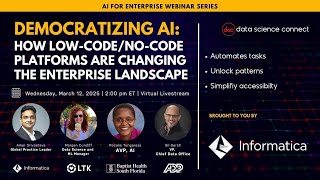
Generative AI has made low-code and no-code tools far more capable. In a Data Science Connect panel sponsored by Informatica, leaders from Informatica, ADP, LTK and Baptist Health South Florida discussed faster experimentation, the risks of skipping fundamentals, shadow AI and how data scientists' roles are shifting.
Key takeaways
- Natural language changed the game. Generative AI lets non-technical users build a first version without writing code.
- Subject matter experts gain most. Low-code tools give experts a head start on manual work they still need to verify.
- Don't skip the fundamentals. Users still need core data science concepts and governance, or they risk trusting tools blindly.
- Experiment wide, then harden. Use low code to test ideas at the top of the funnel, then add governance and custom work as solutions mature.
- Watch for shadow AI. Gerstl warned democratized tools can create unmonitored black boxes, as no-code ETL already has.
Low-code and no-code platforms are not new, but generative AI has changed what they can do and who can use them. In a Data Science Connect expert panel webinar sponsored by Informatica, four leaders discussed what that shift means for experimentation, governance and the role of data scientists: Amar Srivastava, global practice leader at Informatica; Gil Gerstl, VP, Chief Data Office at ADP; Morgan Cundiff, data science and machine learning manager at LTK; and Rosalia Tungaraza, AVP of AI at Baptist Health South Florida. Brian Mink, co-founder and president of Data Science Connect, moderated.
How has generative AI changed low-code and no-code tools?
Drag-and-drop tools have been around for years, Srivastava said, but the tools are now built on AI, with prepackaged recipes and copilots that help people build, so teams can test and move faster.
Gerstl said the key change, starting about two and a half years ago, was natural language understanding. Machines now grasp what non-technical people are actually asking for, which gives these platforms a much bigger role in experimentation.
Tungaraza said people at Baptist Health who are not data scientists are now building AI solutions quickly. That widens experimentation beyond a small group of data scientists who code from scratch. With generative AI, "you don't even have to write code," Tungaraza said. "Use natural language and you get your first version."
Who benefits from democratized AI?
Cundiff said the biggest gain may be for subject matter experts doing highly manual, expert work. In an earlier biology research role, Cundiff said, counting nerves in images of mouse retinas could take weeks for a single experiment, and the team had no budget for a full-time data scientist. Low-code tools for basic edge and brightness detection can now give the expert a head start to verify, instead of highlighting each nerve by hand.
That puts the tool in the hands of the person who has to check the data, without layers of outside consultants in between, according to Cundiff, who expects people to apply these tools in fields a data scientist would never think of.
What are the risks of low-code AI for non-technical users?
The panel's main caution was over-reliance. "Just because it's low code no code does not mean that you can get away from needing to know some of the core concepts," Tungaraza said. Without guardrails, users may trust a tool so much that they skip the fundamentals of data science and proper AI governance.
Cundiff said much of a data scientist's training is spotting patterns in data that a model shouldn't learn to replicate. If that work moves to other experts, the training has to move with it, whether built into tools or provided through consulting.
Srivastava warned against tactical tools that simply stitch AI capabilities together. "The data is the foundation for everything you do in the AI, not the other way around," Srivastava said, so data needs governance and guardrails before it is opened up to everyone.
Gerstl named three limitations: security, compliance and governance, especially since many users are less literate in AI risks; limited flexibility compared with custom code; and scalability, since enterprise applications need to be "as close to bulletproof" as possible.
How should companies balance ease of use, customization and governance?
Cundiff offered "the annoying answer of it depends." Teams can often start with an out-of-the-box tool, test whether it delivers value, and move to a custom build or a contractor only when they hit its limits.
Gerstl described a funnel. The biggest bottleneck is at the top, where engineering capacity limits how many ideas even reach a proof of concept. Low-code tools let business users experiment and show early value, followed by a handoff that adds explainability, governance and guardrails as a solution matures toward repeated or customer-facing use.
Tungaraza said technical staff should use these tools too, cost permitting. An AI idea often only proves itself in a pilot, so starting with low code avoids spending hours on "something that's going to end up in the trash can." Srivastava expects a hybrid of low code and custom modules for some time, but advised keeping customization to what is truly necessary, since it creates maintenance overhead and technical debt.
How will the role of data scientists change?
Gerstl said centralized AI teams are shifting from proving that something works to ensuring solutions are scalable and robust. The ADP leader expects data scientists to take on more governance and monitoring, including accuracy, bias and toxicity, and to serve as educators for the rest of the organization. Srivastava described AI specialists as "AI coaches" for citizen developers and said they will focus on robust architectures, governance models and advanced algorithms.
Cundiff said low-code tools let data science teams test several hypotheses at once, then invest custom modeling only where early results show real impact, instead of waiting months on a custom model that may not pay off.
What governance do democratized AI programs need?
Srivastava said data must be classified by sensitivity and permitted use, with lineage showing where it originated, before role-based access controls apply at the last mile. "Everybody is ready for AI except your data," Srivastava said, citing a phrase Informatica uses.
Gerstl flagged the risk of shadow AI. No-code ETL tools have already created black-box pipelines that aren't monitored or visible centrally, and democratized AI could repeat that pattern.
Tungaraza described two safeguards at Baptist Health: foundational AI literacy training before people build, and a council that reviews solutions at checkpoints from ideation through pilot and production. Gerstl summed up the panel's view: to succeed, organizations "have to balance it with governance and strategic oversight."
Join the next enterprise AI panel
Panels like this one are part of Data Science Connect's free webinar program, which has 24 live sessions on the 2027 schedule across four series: the AI × Enterprise Panel Series, AI Demo Days, Agentic AI Showcases and the Plug & Play Series. Registration for 2027 is coming soon.
Frequently asked questions
What are the risks of low-code and no-code AI?
Panelists cited users skipping data science fundamentals, ungoverned data, limited flexibility, scalability gaps and the spread of unmonitored shadow AI.
Should data scientists use low-code AI tools?
Tungaraza said yes: starting with low code helps technical teams learn quickly whether an idea is worth building before investing hours in custom code.
How will low-code AI change the role of data scientists?
Panelists expect data scientists to act as advisers and educators, focus on governance, monitoring and architecture, and reserve custom models for proven high-impact uses.
How do you govern AI built by non-technical employees?
Panelists recommended data classification and lineage, role-based access, foundational AI literacy training and review checkpoints from ideation to production.
Watch: Democratizing AI: How Low-Code/No-Code Platforms are Changing the Enterprise Landscape on YouTube
Event: Webinars · More coverage: Webinars insights