In the opening keynote fireside chat at COLLIDE 2024, AI and data leaders from Nike, ADP and Yum! Brands looked three to five years ahead. They agreed humans stay in the loop, data can no longer be an afterthought, and governance only works when everyone who creates data takes part.
Key takeaways
- Humans stay in the loop. All three panelists called human oversight one of the most important AI controls, not a temporary step.
- Data can't be an afterthought. Pillai said AI use cases fail without data quality, governance, cataloging and observability.
- Execution beats new strategy. Pirzada said the data playbook hasn't changed much, but redundant copies of the same data are a real cost.
- Governance should enable. Eshelman said friction drives people around controls, so access processes must be clear, documented and fast.
- Everyone owns governance. Employees need to classify the documents they create because AI can surface them in seconds.
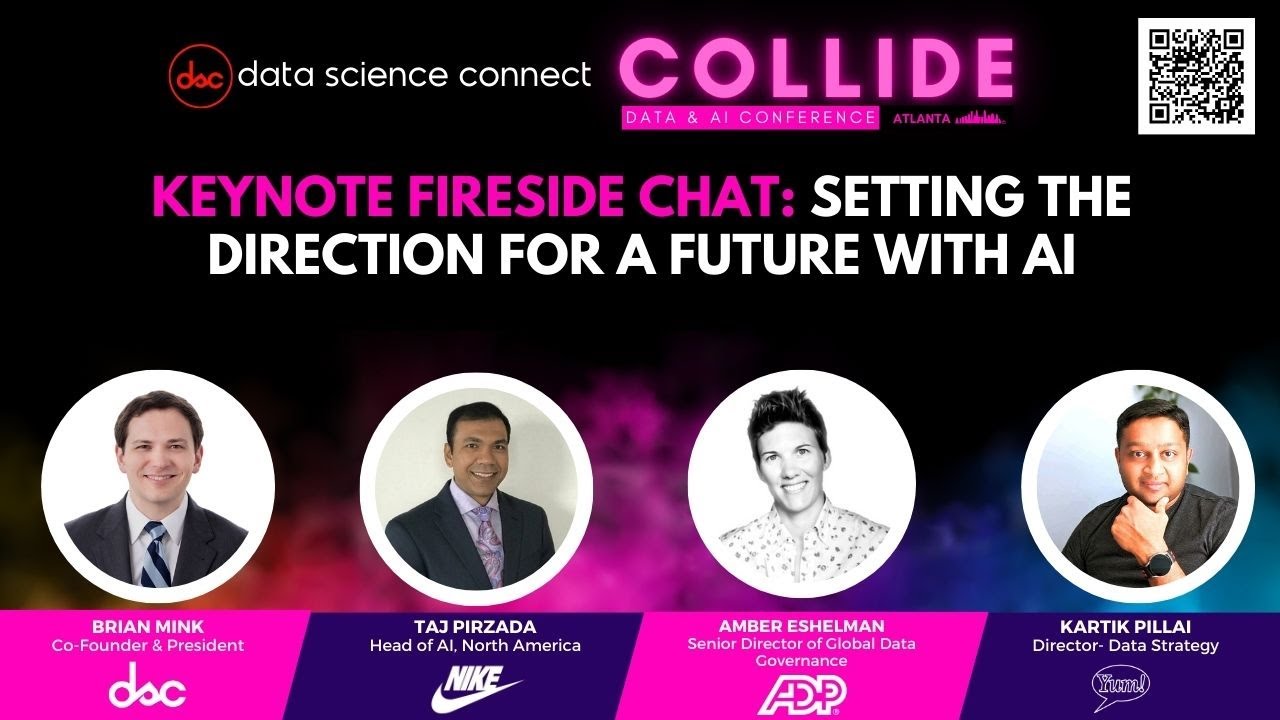
What will AI look like inside large companies three to five years from now, and what has to be true for it to work? That was the question behind the opening keynote fireside chat at COLLIDE Data & AI Conference 2024 in Atlanta. Brian Mink, co-founder and president of Data Science Connect, moderated a conversation with Taj Pirzada, Head of AI, North America at Nike; Amber Eshelman, Senior Director of Global Data Governance at ADP; and Kartik Pillai, Director of Data Strategy at Yum! Brands.
The panelists described very different jobs. Pirzada runs a large team of data engineers, data scientists and machine learning engineers and owns Nike's AI governance automation end to end. Eshelman has spent almost 18 years at ADP, starting as a data analyst and now focused on global data and AI governance. Pillai supports data analytics and the data platform for Pizza Hut in about 120 countries and leads data governance and privacy for the brand.
What future AI capabilities are enterprise leaders hoping for?
Pillai started with a restaurant problem. He cited industry statistics showing about 18% of drive-thru orders are wrong, which can cost a restaurant a returning customer. His wish list was a fully automated, integrated kitchen that gets a complicated coffee order right every time.
Pirzada kept his horizon to three to five years, saying the field changes too fast to look further. His backlog already holds 300 to 400 use cases from HR, payroll, marketing and content development. He expects "added intelligence" in every device and application, along with point solutions such as a benefits app that walks employees through open enrollment.
Eshelman said her goal is safe enablement of AI: controls, guardrails and monitoring. "The irony is we're building models to manage models," she said, adding that a human still has to oversee the process.
Will AI automate people out of their jobs?
All three panelists argued that human oversight isn't going away. Eshelman said AI is creating new roles in data protection, privacy, security and access. "One of the greatest controls that we have for AI is the human in the loop," she said.
"For the record, I never built a system without a human in the loop," Pirzada said. He described Nike's best generative AI prompt writer as a procurement employee, not one of the company's roughly 11,000 engineering staff. His advice was to build skills AI can't replace. If a job is mostly clicks with no processing, those clicks can be automated, he said.
Pillai said reducing repetitive tasks frees people for more meaningful work. He pictured AI condensing hour-long trainings that few people remember, and a prompt on a wearable device reminding a restaurant worker of the next step in a start-of-day procedure.
How does AI change an organization's data strategy?
"For a lot of organizations, data is usually an afterthought," Pillai said. That will change, he predicted, once companies find they can't execute AI use cases without data quality, governance, a data catalog and observability in place.
Pirzada said the strategy itself hasn't changed much. Capture what you can, put it in a data lake and get it ready for AI with a semantic layer. Execution is the hard part. He has seen seven versions of the same data because seven groups worked on it separately. He also pointed to generative AI's ability to create synthetic data that mirrors real data sets, which highly regulated industries can use without exposing personally identifiable or health information.
Eshelman said governance now has a seat at the table and needs to be seen as enablement rather than red tape. Access requests should be tied to documented use cases and time-bound when necessary. "The second you become a friction point, the more people want to move around you," she said.
What cultural changes does becoming AI-first require?
For Pirzada, the biggest shift is collaboration. His calendar is full of meetings with legal, privacy, brand protection, vendor management and an acceleration office. Leaving any group out invites resistance, even to good ideas, he said. Success is ultimately measured in dollars and cents, so teams must show how AI benefits the business.
Pillai said business units also need to become agile, not just software teams, and be willing to change direction when data supports a different decision.
Eshelman focused on everyone who creates data. Employees save documents without considering that AI can surface them in seconds to someone who shouldn't see them. She wants employees to think about classification, such as marking an NDA as restricted. "It takes a village. Everybody owns governance," she said, noting the challenge of getting 60,000 people to think that way.
What excites and worries AI leaders?
In a closing lightning round, Pillai said he is excited about AI improving health and connectivity, and worried that U.S. regulation still hasn't caught up to Europe's GDPR. Pirzada pointed to AI-personalized learning that could help uncomfortable employees adapt, and worried about whether he can convince senior leaders to give teams the time and space to address barriers to success. Eshelman cited the "art of the possible" and the human responsibility to use AI well, quoting Spider-Man's Uncle Ben on great power and great responsibility.
Hear more enterprise AI leaders at COLLIDE 2027
COLLIDE, the largest AI conference in the Southern U.S., brings more than 1,000 enterprise data and AI leaders to Atlanta for keynotes and panels like this one. The 2027 conference takes place Wednesday, October 13, 2027, at the Sandy Springs Performing Arts Center. Registration is coming soon. Between conferences, Data Science Connect hosts free live webinars with enterprise AI practitioners.
Frequently asked questions
Will AI replace human oversight in enterprises?
The panelists said no. Eshelman called the human in the loop one of the greatest controls for AI, and Pirzada said he has never built a system without one.
How does AI change a company's data strategy?
Pillai said companies will learn they can't execute AI use cases without data quality, governance, a catalog and observability, while Pirzada said the challenge is execution, such as eliminating redundant data sets.
What does an AI-first culture require?
Cross-functional collaboration with legal, privacy and brand teams, agile business decisions, and employees who think about how the data they create could be surfaced by AI.
How can synthetic data help AI in regulated industries?
Pirzada said generative AI can create data sets that mirror real data without exposing personally identifiable or health information, so teams can share and experiment safely.
Watch: KEYNOTE FIRESIDE CHAT: Setting the Direction for a Future With AI on YouTube
Event: COLLIDE AI Conference · More coverage: COLLIDE AI Conference insights