Visualize Your Own Data: Drawing the Future of AI With Piccles
At the 2024 AI Connect K-12 Data Science Conference, Piccles founder Chris Bent had attendees draw answers about their mood, AI skills and the future of AI. The shared drawings showed optimism, worry and a case for keeping creativity human.
By The AI Enterprise Magazine Team4 min read
Key takeaways
- Drawings as data. Piccles collects drawings in real time so a group's feelings and opinions show up as a shared picture.
- Color as a scale. Attendees used green, yellow and red to show AI proficiency, and Bent summed it up as trending toward the higher levels.
- Mixed views of AI's future. Drawings showed bright roads ahead alongside fears of misuse and control by a few.
- Keep creativity human. Bent said outsourcing creativity to AI is a disservice, since the struggle of creating is part of being human.
- Emotion is human. His own test found AI does not understand emotions such as love.
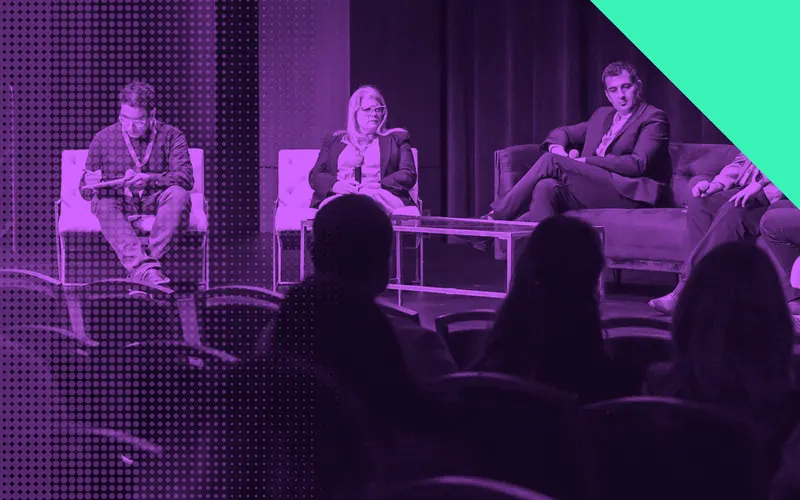
In a 2024 AI Connect K-12 Data Science Conference session, Chris Bent, founder of Piccles, had students and educators draw their answers to questions about AI on their phones and watched the results build into a shared picture on screen. The interactive virtual session ran late in the day, shortly before the conference's final panel, and used drawings as a data source about how a group feels and thinks.
Bent said the name Piccles combines "pictures" and "pixels," not the snack. He described the platform as one that lets everyone create their own data, share it and "together form the bigger picture" of how a group, community or classroom feels about a subject.
What is a drawing-based data visualization tool?
Participants scanned a QR code or opened a link in the chat, then drew in a white box with a brush-size selector and a color palette. Every drawing appeared in real time on the shared screen.
Bent said the aim is open-ended, authentic expression, because text and speech alone can feel constricting. He admitted he was hesitant to add an undo button because he wanted people to share without worrying about being perfect. The tool also recently gained the ability to replay each brush stroke, which let the group watch one student draw a graduation scene.
His first prompt asked for a self-portrait showing how participants felt that afternoon. Bent summarized the result as "pretty awesome" overall, with a mix of faces, scribbles and a happy face in the clouds.
How proficient do students feel with AI?
The second question asked how proficient people felt with AI, using color as the data. Green meant an expert, a small green dot or plus sign meant pretty good, and red meant just starting out.
Bent drew himself in red, saying he works with people who are much better at data science than he is. The audience, by contrast, showed a lot of green and some yellow. He summed it up as "all over the map but definitely trending towards the higher levels."
A follow-up prompt asked for the grade participants would give themselves in data science. Answers ranged from A's to D's, one perfect "50 out of 50" and several "I am learning" responses. Bent said learning is a common answer because the industry is not very old.
What do students think the future of AI looks like?
For the third prompt, Bent asked students to imagine the future of AI, including what they want it to look like, since they will be building the next versions of the algorithms and data sets. He mentioned companies such as Google, Nvidia and Salesforce as examples of those working on AI.
Responses were mixed. Some drawings showed bright roads ahead. Others expressed worry that AI will be used negatively or maliciously, that it will be used to build guns, or that it could end up controlled by a few people. One participant, Chelsea, said in the chat that she wants safety and regulatory policies so that things do not get out of control. A license-restricted future was another answer.
Bent said both views can be right. "There's no certainty with this because it is innovative," he said, and that is what makes it exciting and scary. Jobs will be created and lost, and how people react will determine the outcome.
What does it mean to be human with AI?
The final question asked what humans will do with their time if AI takes over mundane, repetitive tasks. Students drew music, art, love, emotion, a soul and one capybara.
Bent drew on an experiment of his own. He said he asked AI to sort drawings by joy, fear and love, and found that it does not understand those emotions. "AI doesn't know what love feels like," he said. "It might know the word."
He also argued for keeping creativity human. "When we outsource our creativity to AI we are doing ourselves a disservice," he said, because the struggle of creating, trying and exploring is part of being human.
What did Bent say about drawings as data?
Bent said he plans to use the drawings to create content to share afterward. Piccles is being used in a range of settings to create and organize data visualizations, now with AI, he said. His team is trying to do with drawings what text-based large language models do with words, because drawings carry a lot of data, including emotion.
His advice to participants was to play with AI, experiment and get their hands dirty. He said that as long as people keep a "let's see what happens" mindset, they will be successful.
Explore more with AI Connect
For more hands-on sessions on data and AI, AI Connect's 24 free live webinars on the 2027 schedule run in four series: the AI × Enterprise Panel Series, AI Demo Days, Agentic AI Showcases and the Plug & Play Series. See the webinars page for details. Registration for 2027 events is coming soon.
Frequently asked questions
What is Piccles?
A platform founded by Chris Bent that lets participants draw their own data and share it so a group's feelings and opinions form a bigger picture.
How did attendees rate their AI skills?
Using green, yellow and red drawings, most showed green and yellow, which Bent summarized as trending toward higher levels.
What did attendees think about the future of AI?
Responses were mixed, from bright futures to worries about misuse, control by a few people and calls for safety and regulatory policy.
What does it mean to be human with AI, according to Bent?
He argued that creativity, emotion and the process of exploring are uniquely human and should not be outsourced to AI.
This article is based on remarks by Chris Bent, Founder, Piccles at AI Connect K-12 Data Science Conference 2024 on July 25, 2024. More coverage: More AI Connect Events.
Filed under: AI Use Cases & Applications, People, Culture & Leadership