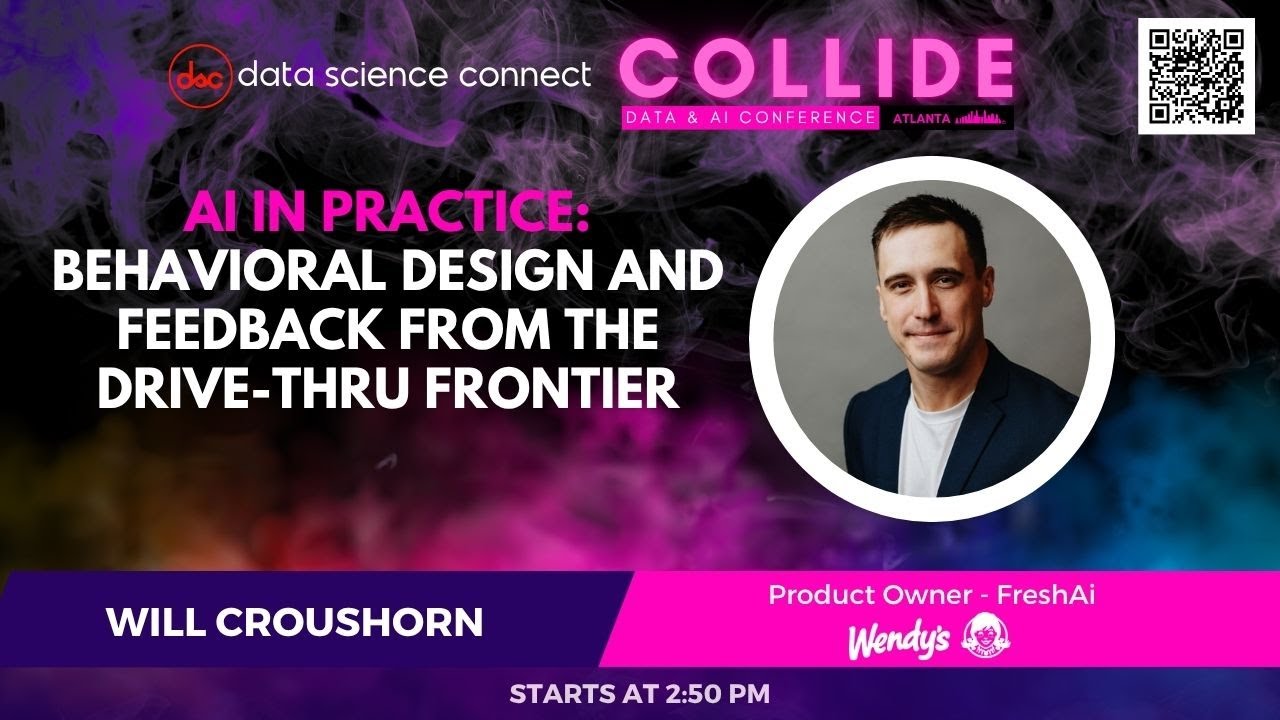
Wendy's FreshAi, built with Google Cloud, now takes 95% of orders at its AI drive-thrus. At COLLIDE 2025, product owner Will Croushorn explained how small behavioral signals, Reddit and TikTok posts, and a new 'sorry' metric shape the product, and how the team improved it for customers who stutter.
Key takeaways
- 95% of orders. FreshAi handles 95% of drive-thru orders at Wendy's AI locations, about 150,000 orders a day, Croushorn said.
- Word choice is data. Saying "chicken biggie bag" signals about a 60% chance the customer knows the menu.
- Every syllable has a cost. A short upsell phrase added nearly 50 minutes of drive-thru time a day.
- Count the sorries. Tracking how often the agent apologizes exposed friction; the team cut it by about 60%.
- Accessibility at scale. Testing with a customer who stutters led to updates that help about 10,000 people a day.
Wendy's AI drive-thru now handles 95% of orders at the locations where it runs, according to Will Croushorn, Product Owner for FreshAi at Wendy's. At COLLIDE Data + AI Conference 2025 in Atlanta, Croushorn described what the team has learned from building FreshAi, a generative AI ordering platform developed with Google Cloud, and how small details of customer behavior became some of its most valuable data.
How does Wendy's use generative AI in the drive-thru?
About 80% of Wendy's business goes through a drive-thru, Croushorn said, which made it the obvious place to start. About three years ago, before ChatGPT, Wendy's and Google Cloud set out to answer a simple question: could generative AI take an order? The first test was "a small little crew with a screen and a microphone and duct tape," he said.
Today, Croushorn said, FreshAi takes orders in English and Spanish, has served more than 15 million customers in 30 states, and processes about 150,000 orders a day. He said it was in about 350 locations, with plans to reach about 600 by the end of the year.
A drive-thru looks simple, but "there are no two orders that are the same," Croushorn said. He said there are more than 200 billion ways to order a Dave's Double in English alone. Customers change orders mid-sentence, get confused and feel pressure from the cars behind them. For customers who stutter, have hearing problems or are autistic, the stress is greater.
What customer behavior data matters most for drive-thru AI?
Croushorn said he has spent more than a thousand hours over the past year watching what happens in drive-thrus, looking for friction. Some findings were small and specific. Customers take about four seconds to pull up and roll down the window, so an early greeting often went unheard.
Word choice carries signals too. If a customer orders a "chicken biggie bag," Croushorn said, there's about a 60% chance that person already knows the menu. Simply asking for "a biggie bag" suggests a newer customer, who might benefit from help with the menu or a suggestion.
Small changes add up at scale. When marketing wanted the agent to ask, "Would you like to try a Frosty?", Croushorn said that phrase of a few seconds added up to nearly 50 minutes of drive-thru time over a day. Long lines send customers to the restaurant down the street, so the team weighs the value of each upsell against shorter waits. "Understanding the impact per syllable or the impact per word" now guides those decisions, he said.
How do Reddit and TikTok feed product decisions?
Croushorn said some of his most useful feedback comes from social media. Customers film their own FreshAi orders and post them on TikTok, and commenters weigh in on what worked. Reddit threads do the same. Together with conversations with crew members, he said, those posts show where the pain points are, not just what customers intended to order.
The team also created a metric it had never tracked before: how often the agent says "sorry." An apology usually means the agent or the customer didn't understand something, so it marks friction. Croushorn said the team has cut that count by about 60% over the past few months.
How can AI make the drive-thru more accessible?
Croushorn sees accessibility as a key differentiator, a way to "make the road wider" so more people can order. That includes adding languages, with Canadian French in development, and serving customers with atypical speech, such as people who stutter or have Parkinson's.
He showed a video posted by Travis, a speech and accessibility coach who stutters, ordering at a traditional drive-thru. The crew member meant well, Croushorn said, but kept interrupting and guessing at what Travis was trying to say. Travis had told him he was too nervous to use a drive-thru until age 19, and after one bad experience didn't return for two years.
Wendy's invited Travis to spend a couple of hours taking test orders with the team. In the follow-up video, the agent waited, didn't interrupt and told him, "Feel free to take your time. I'm here whenever you're ready." Croushorn said the updates from that session now make ordering easier for about 10,000 people a day.
AI can't replace everything, he added. The smile when a crew member hands over fries is human connection that "agent would never be able to do."
What lessons apply beyond fast food?
Croushorn closed with four principles:
- Build for humans, not just use cases. Use your own product repeatedly to find friction, and avoid "AI for AI's sake."
- The fundamentals never change. Customers will always want fresh food, fast and consistent, regardless of which model ships next. Every Gemini update has made FreshAi better, he said, rather than threatening it.
- Feedback is not a bonus. "It's your signal layer."
- Never stop being curious. Curiosity, he said, is how unrelated ideas combine into new ones.
Hear more real-world AI stories at COLLIDE 2027
COLLIDE, the largest AI conference in the Southern U.S., brings more than 1,000 enterprise data and AI leaders to Atlanta for case studies like this one. The 2027 conference takes place Wednesday, October 13, 2027, at the Sandy Springs Performing Arts Center. Details are on the COLLIDE event page.
Frequently asked questions
How many orders does Wendy's FreshAi handle?
Croushorn said FreshAi processes about 150,000 orders a day and handles 95% of drive-thru orders at Wendy's AI locations, in English and Spanish.
Who built Wendy's drive-thru AI?
Wendy's developed FreshAi in partnership with Google Cloud, starting about three years before the talk.
How does Wendy's measure friction in AI drive-thru orders?
One metric is how often the agent says sorry, which usually signals a misunderstanding. Croushorn said the team cut it by about 60% over a few months.
How can AI drive-thrus help customers with speech differences?
After testing with a customer who stutters, Wendy's tuned the agent to wait without interrupting, which Croushorn said now helps about 10,000 people a day.
Watch: AI In Practice: Behavioral Design and feedback from the Drive-Thru Frontier on YouTube
Event: COLLIDE AI Conference · More coverage: COLLIDE AI Conference insights