At COLLIDE 2025, AI leaders from Walmart, AT&T, Kellanova and TelevisaUnivision explained how they build trust in AI agents with employees and customers. They described AI boards and councils, non-negotiable guardrails, the risks of model upgrades and Walmart's plan to anchor every agent to four super agents.
Key takeaways
- Culture comes first. Gandavarapu said Walmart treats AI as a core capability, with no separate AI and non-AI projects.
- Earn trust on everyday problems. The top question Walmart's Sparky agent gets is "where is my order?"
- Formal review gates. AT&T routes every generative AI project through an AI board, steering committees and legal review.
- Model upgrades are a governance risk. Patel said a new model version can change downstream behavior and force extensive retesting.
- Fight sprawl with a few anchors. Walmart ties every agent to four super agents for customers, associates, merchants and sellers, and developers.
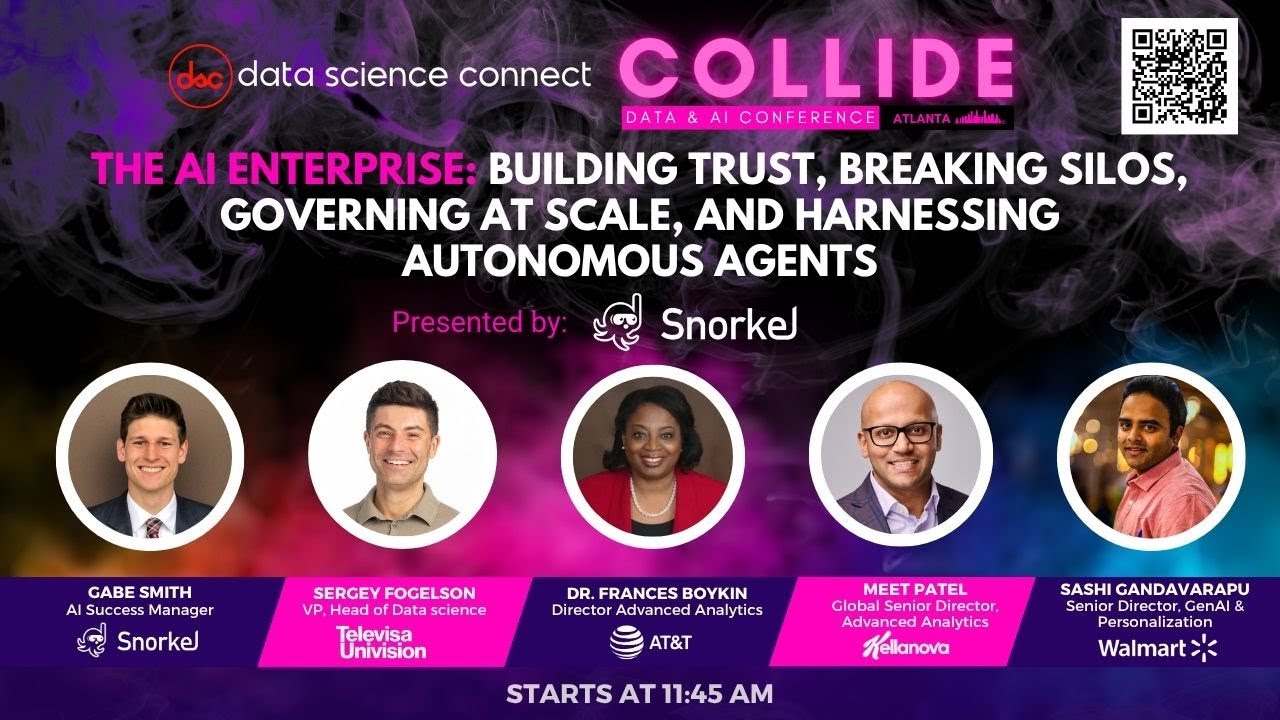
Enterprise AI leaders from Walmart, AT&T, Kellanova and TelevisaUnivision told a panel audience at COLLIDE Data + AI Conference 2025 in Atlanta that scaling AI agents depends as much on culture, trust and governance as on models. The session was sponsored by Snorkel AI and moderated by Gabe Smith, AI Success Manager at Snorkel AI.
The panelists were Meet Patel, Global Senior Director, Advanced Analytics at Kellanova; Dr. Frances Boykin, Director Advanced Analytics at AT&T; Sashi Gandavarapu, Senior Director, GenAI & Personalization at Walmart; and Sergey Fogelson, VP, Head of Data Science at TelevisaUnivision. Smith noted that the panelists' comments did not reflect the views of their organizations.
What does scaling AI in the enterprise actually require?
Boykin said scaling involves tooling, culture and organization together, and that AT&T has a team dedicated to explaining what AI and generative AI mean for the business. Patel called those three a tripod that can't stand without each leg. At Kellanova, he said, the hardest problems are prioritizing use cases by value, aligning the organization and driving adoption once a solution is built.
Gandavarapu said culture comes first and starts at the top. Walmart has publicly described itself as aiming to be a people-led, tech-enabled omnichannel retailer, which he said gives teams a mandate to invest in AI. "There are no AI projects and non-AI projects anymore," he said. Tooling comes later, such as an AI gateway that gives developers one place to reach large language models.
How do you build trust in AI with employees and customers?
Boykin said some colleagues have told her they won't help build generative AI because it might take their jobs. Her response is that every technology shift, from the arrival of computers to analytics, has found a place for everyone. "There's a place for everyone. We just need to find your place," she said.
For customer-facing agents, Gandavarapu said, trust is harder to win back once it's lost. Walmart launched Sparky, its customer-facing agent, with features such as building baskets and planning birthday parties. Yet the number one question it gets, he said, is "where is my order?" Solving those everyday problems earns the trust to take on bigger tasks, he said, and the system has to be transparent with users.
How are enterprises governing generative AI and agents?
At AT&T, Boykin said, an AI board within the data organization oversees smaller steering committees, and every generative AI project must go through an approval process that weighs ROI and includes legal review. She said she takes issue with the focus on money, because some of the best projects are grassroots efforts that help people do their jobs better.
Fogelson offered what he called a "spicy take." Because companies can't see inside foundation models or guarantee their outputs, he said, buyers should push back on model providers and hold them responsible for legal and reputational damage when outputs go badly wrong. Without that, he said, internal governance can only do so much with a "gigantic black box." His own approach has been to deploy agents where outputs are easy to verify, such as automating routine status emails or enriching metadata on existing content.
Gandavarapu listed non-negotiables for Walmart's customer-facing agent: role-based access, fairness and transparency, continuous monitoring and operational metrics. Human review is required, he said, for anything touching payment systems or customer data.
Why do model upgrades and global rules complicate AI governance?
Patel said Kellanova's use cases go through an AI council for approval, then a pilot, and only then a scaling phase. A tricky decision is version control. A model may be tuned on GPT-4 when GPT-5 arrives, he said, and an upgrade can change behavior downstream, forcing many rounds of testing.
As a global company, Kellanova also has to account for strict rules such as GDPR in Europe. Legal and privacy teams are learning alongside the data teams, Patel said, and "there's not a right solution" or playbook yet.
How can enterprises avoid agent sprawl?
Boykin said the bigger challenge at AT&T is not resistance but demand. Many teams want their own generative AI, which makes governance, ethics and legal review hard to enforce.
Gandavarapu said Walmart addressed this by anchoring all generative AI work to four "super agents": one each for customers, associates, merchants and sellers, and developers. Every agent built across the company feeds into one of those four. Within about three months of adopting that common terminology, he said, it became clear who was working on which super agent.
Patel described a complementary approach: giving employees tools such as Copilot to build their own bots and process automations. Some of those internal examples are good enough to share with other regions, he said.
In closing, Boykin said alignment has to come from the top. Fogelson said trust comes through transparency and incremental wins. Gandavarapu said that while cycle times have shrunk, the fundamentals have not changed: start from the customer problem and articulate the business value.
Join the conversation at COLLIDE 2027
COLLIDE, the largest AI conference in the Southern U.S., brings more than 1,000 enterprise data and AI leaders to Atlanta for panels like this one. The 2027 conference takes place Wednesday, October 13, 2027, at the Sandy Springs Performing Arts Center. See the COLLIDE event page for updates, with registration coming soon.
Frequently asked questions
What are Walmart's super agents?
Gandavarapu described four enterprise super agents, for customers, associates, merchants and sellers, and developers. Every generative AI project at Walmart is tied to one of them.
How does AT&T govern generative AI projects?
According to Boykin, an AI board in the data organization oversees steering committees, and every generative AI project goes through an approval process that considers ROI and includes legal review.
What guardrails do customer-facing AI agents need?
Gandavarapu listed role-based access, fairness and transparency, continuous monitoring, operational metrics and human review for anything touching payments or customer data.
How do you build employee trust in generative AI?
Boykin said leaders should address job fears directly and show each person where they fit, since past technology shifts have found a place for everyone.
Watch: The AI Enterprise: Building Trust, Breaking Silos, Governing at Scale,& Harnessing Autonomous Agents on YouTube
Event: COLLIDE AI Conference · More coverage: COLLIDE AI Conference insights