





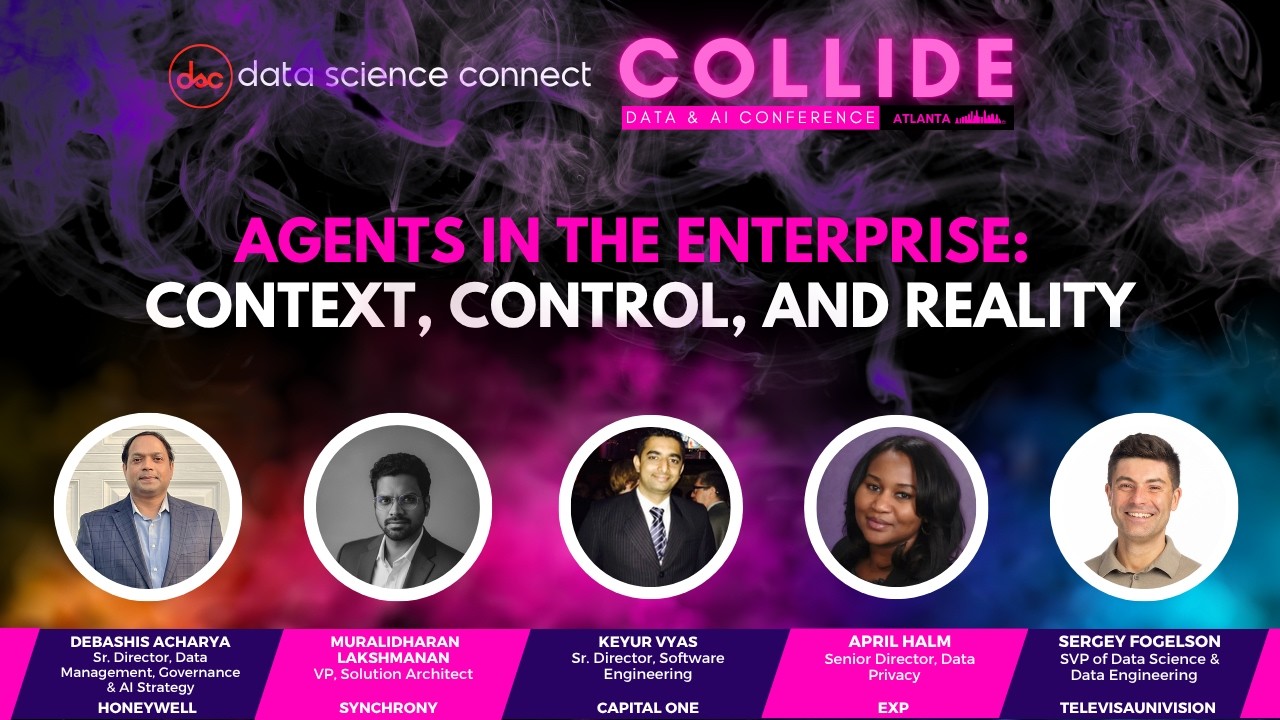
Data and AI leaders from Honeywell, Capital One, Synchrony, TelevisaUnivision and EXP Realty compared notes at COLLIDE 2026 on moving AI agents from demo to production. They covered real use cases, context engineering, agent memory, least-privilege access and how to make agent behavior auditable.
Key takeaways
- Agents fail quietly. Unlike scripted workflows, agents can return results that look correct but are semantically wrong.
- Start where mistakes are cheap. Panelists described agents that recommend upgrades, find root causes and review documents, with humans still deciding.
- Context is the differentiator. Tools, permissions, governance rules and fresh data matter more than access to frontier models.
- Remember only what's necessary. Pull policies from authoritative sources and treat personal data as ephemeral.
- Grant least privilege and log every step. Start from a deny list, and persist agent state so actions can be audited.
Most enterprises have seen a successful AI agent demo. Getting that agent into production, with the uptime, consistency and observability of any other business application, is where the roadblocks start. That was the focus of "Agents in the Enterprise: Context, Control, and Reality," a panel at COLLIDE Data + AI Conference 2026 in Atlanta.
Debashis Acharya, Senior Director and leader for data management, data governance and AI strategy at Honeywell, moderated. Panelists were Sergey Fogelson, who leads data science and data engineering at TelevisaUnivision; April, who leads data privacy at EXP Realty; Keyur Vyas, Senior Director, Software Engineering at Capital One; and Muralidharan Lakshmanan, VP, Solution Architect at Synchrony. Acharya noted that the panelists' views were their own.
How are AI agents different from traditional automation?
Vyas compared scripted workflows to trains and agents to self-driving cars. A train runs smoothly on its tracks, but if a workflow expects a PDF and gets a CSV, "it just stops, breaks, or fails," he said. An agent can find another route. That autonomy is also why agents need much more governance, he said.
Lakshmanan, speaking from financial services, said agentic AI is "like riding a Lamborghini, but you're not running it in a racetrack." It has to follow the rules of the road.
Fogelson flagged a subtler risk. Traditional systems fail loudly. Agents always try to succeed, so outputs can look correct while being semantically wrong. "The response that you're getting from the system might not actually be correct," he said.
Where are AI agents delivering value in production today?
Panelists described several working use cases:
- Infrastructure upgrades at TelevisaUnivision. Fogelson said an agent runs each quarter to map package dependencies and conflicts before upgrades, work that used to take a person two or three days. It recommends; humans still do the upgrade.
- Site reliability at Capital One. Vyas said an SRE agent reads logs and checks recent releases to find root causes, such as a library update that broke a certificate, turning hours of overnight troubleshooting into minutes.
- Transaction documents at EXP Realty. April said an agent reviews documents, flags errors and pulls missing information so deals close faster.
- Customer service, tech support and sales prep, which Acharya cited as common commercial uses.
Lakshmanan said agents work best where mistakes are cheap and reversible. He treats them like new hires, granting "progressive autonomy" as they prove themselves. At an internal MCP hackathon he ran, the winners were mostly business users who defined the agent's job and data well, not those with the best prompts.
Why does context engineering matter for AI agents?
Context is far more than a prompt, Vyas said. It includes the tools an agent can use, the systems it can reach and the governance rules it follows. Access to frontier models won't set companies apart, he said. The harness and context design will. Teams also have to avoid overloading or poisoning the context, so "the noise is not poisoning the signal."
Acharya offered a metaphor: if the LLM is the car's engine, "rest everything is the context," including permissions, retrieval, memory, policies and data lineage. Good context also helps keep token and cloud costs under control, he said.
What should an AI agent remember or forget?
Vyas said agents should keep critical context, such as a customer being in the EU and subject to GDPR, but treat any personal data they pull as ephemeral. Fogelson said an analytics agent should remember which core tables matter across sessions, but not carry one user's question into another user's conversation.
Acharya's rule was necessity. Agents should pull policies and definitions from the authoritative source each time instead of caching them, and should not retain sensitive data. "Read that and don't remember," he said.
How much access should an AI agent have?
Start with least privilege, panelists agreed. Vyas recommended starting from a deny list. If an MCP server offers four read functions and one write function, an agent that only reads shouldn't get write access, he said. Lakshmanan compared tool descriptions to signs on doors: vague labels lead to vague access. April said data minimization is the key principle in her work.
Acharya added ephemeral credentials for sensitive access and human checkpoints for any high-impact action.
How do you make agent behavior observable and auditable?
A tool reporting success isn't enough, Vyas said. An agent may report a refund as complete, but was it the right customer? He said teams should persist the agent's state at every step so they can reconstruct why it acted. Acharya called this following the agent's trajectory. April said she frames it for teams as making the agent "auditable," a term familiar from SOX compliance.
In a closing lightning round, Vyas warned that "garbage in is a confident garbage out in an AI world." Fogelson named cost, April expert knowledge and Lakshmanan the level of autonomy as the most underestimated factors. Acharya urged teams to start data quality work alongside agent design: "Don't wait 5 years for your data to be perfect."
Agentic AI in practice at COLLIDE 2027
COLLIDE, the largest AI conference in the Southern U.S., returns Wednesday, October 13, 2027, to the Sandy Springs Performing Arts Center in Atlanta, bringing together more than 1,000 enterprise data and AI leaders for panels like this one. Learn more about COLLIDE, or join Data Science Connect's free 2027 webinars, including its Agentic AI Showcases.
Frequently asked questions
How are AI agents different from RPA or scripted workflows?
Scripted workflows follow fixed logic and stop when inputs change. Agents pursue a goal, use LLMs and tools, and can adapt, which is why panelists said they need stronger governance.
What is context engineering for AI agents?
Designing everything an agent works with beyond the prompt: the tools it can use, the systems it can access, governance rules, memory and the data it retrieves.
What should an AI agent remember?
Panelists said agents should keep critical, reusable context such as regulatory constraints or key data relationships, but forget sensitive personal data and question-specific details between sessions.
How do you make AI agents auditable?
Persist the agent's state at each step and track its trajectory, including what it retrieved and which tools it called, so teams can explain why it acted as it did.
Watch: Agents in the Enterprise: Context, Control, and Reality on YouTube
Event: COLLIDE AI Conference · More coverage: COLLIDE AI Conference insights


