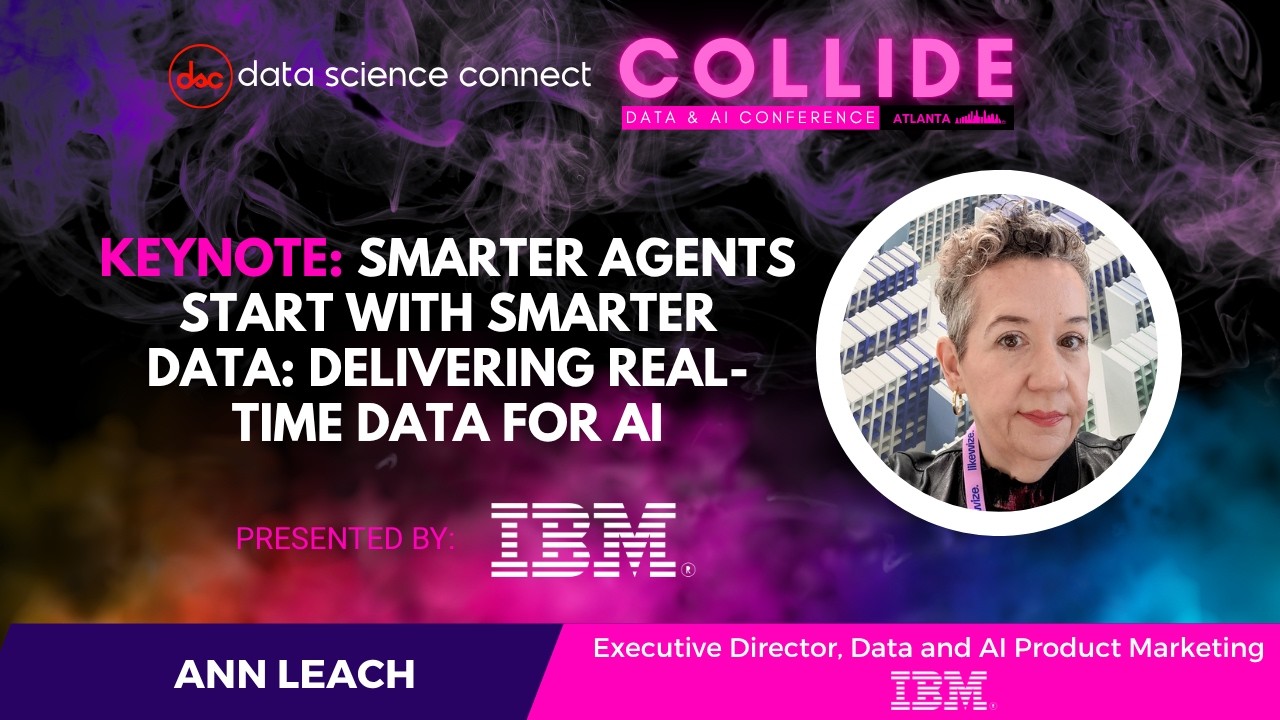
At COLLIDE 2026, IBM's Ann Leach argued that agents can only act as fast as their data allows. She introduced the streamhouse, a real-time layer that complements the lakehouse, and shared how Ferrari used live telemetry and AI to double daily app users.
Key takeaways
- Data speed sets business speed. Leach said a fast agent on stale data still leaves the business slow.
- Freshness is a trust issue. An agent can repeat a mistake at machine speed where a person would pause.
- Three gaps hold agents back. Single-system agents, pipeline sprawl and stale open tables keep context out of date.
- The streamhouse complements the lakehouse. It continuously captures, processes and governs the current state of the business.
- Ferrari shows the payoff. Live telemetry plus AI doubled daily active users and raised time in the app 35%, Leach said.
An AI agent can only decide as well as its view of the business allows, and in most enterprises that view is minutes or hours old. Ann Leach, Executive Director, Data and AI Product Marketing at IBM, made that case in a keynote at COLLIDE Data + AI Conference 2026, held October 1 at the Sandy Springs Performing Arts Center in Atlanta, where she introduced an architecture she called the streamhouse.
When Leach asked the audience who had implemented agents, many hands went up. Far fewer stayed up when she asked who felt their agents were ready to scale across the enterprise.
What is "smarter data" for AI agents?
Smarter data doesn't mean more data, Leach said. It means data that is current, contextual and governed, and available at the moment an application or agent needs to act. Governance "shouldn't be an afterthought," she said.
She placed this within what IBM calls the AI operating model, built around four questions: Do we understand the business in real time? Can we turn that understanding into action? Can we keep AI-enabled work running reliably and economically at scale? And can we do it across the environments the enterprise already has? Leach said companies use the model to build consensus, since no single person owns the whole effort. Her keynote focused on the first question, intelligent data.
Why does real-time data matter more for agents than for dashboards?
For decades, the model was business intelligence, said Leach, who once ran product management for IBM's Cognos. Data arrived in batches, a person read a report, and then made a decision. That model was built for software used by people. Now software is increasingly used by other software.
An agent doesn't just report that a transaction looks suspicious. It can hold the transaction or route it for review. It doesn't just analyze delivery costs. It can reroute shipments. That shrinks the distance between signal, decision and action, and makes data freshness the limiting factor. "The speed of my data defines the speed of my business," Leach said. "And if the data's stale, the agent might be fast, but the business is not."
The risk grows with autonomy, she added. A person looking at stale information might notice something is off and pause. An agent can act on wrong information repeatedly at machine speed, making the mistake harder to contain. "Real-time data is not simply a speed requirement. It's a trust requirement," she said.
What keeps enterprise data from being agent-ready?
Leach cited figures showing only 32% of workloads use agentic AI, while 72% of organizations report that insufficient real-time data infrastructure is blocking AI at scale. She pointed to three causes:
- Single-system agents: agents confined to one system of record understand that application but not the wider business situation.
- Pipeline sprawl: every new use case tends to need another pipeline, another copy and another integration to maintain.
- Stale open tables: querying open tables directly removes some data movement, but if a source was refreshed an hour ago, the agent still sees an hour-old business.
Analytics teams are finding that 15 minutes, or even five minutes, isn't fast enough, Leach said, and in some situations 10 seconds is too slow.
What is a streamhouse?
Warehouses supported internal analysis and lakehouses extended that to analytics and model development, Leach said. But as software moves from analyzing the business to running it, companies need architecture that continually represents what is happening now.
She described the streamhouse as an extension of lakehouse principles into real-time operations. It connects to databases, cloud infrastructure, applications, devices and events, then captures, processes and governs data continuously so applications, agents and lakehouses can use current context with low latency. It is always current, decentralized to meet data where it lives, and built for mission-critical workloads rather than every use case.
It complements the lakehouse instead of replacing it, she said. "The lakehouse explains what happened, the streamhouse powers what happens next."
Leach said IBM and Confluent have been building toward this architecture with customers for years. She described three outcomes: better decisions from fresh, governed context; simpler infrastructure, because data is connected once and reused across consumers; and faster time to value, because data is cleaned, enriched and governed while in motion.
How did Ferrari use real-time data and AI agents?
Leach's example was Ferrari, which wanted to turn its app into a live global experience for racing fans without replacing its existing technology. IBM helped unify telemetry and data across on-premises and cloud environments, she said. AI models generated race summaries and storylines from live telemetry combined with historical data, and agent capabilities assisted with real-time race strategy recommendations.
Governance kept model outputs consistent with brand context. "There's nothing worse than a model hallucinating and sending it out to millions of fans as a race was happening," Leach said. The integration, which included Salesforce, modernized Ferrari's environment rather than replacing it.
According to Leach, daily active users doubled, time spent in the app rose 35%, fan reach grew to 380 million, and Ferrari saw time to value in five months. She called it a data, agent, governance and hybrid cloud story at once, with IBM's Confluent, watsonx, HashiCorp and Red Hat portfolios each covering part of the operating model.
See more data and AI architecture at COLLIDE 2027
COLLIDE, the largest AI conference in the Southern U.S., returns to the Sandy Springs Performing Arts Center in Atlanta on Wednesday, October 13, 2027, with more than 1,000 enterprise data and AI leaders expected. Data Science Connect's free webinars cover real-time data and agentic AI between conferences.
Frequently asked questions
What is a streamhouse?
As Leach described it, an architecture that extends lakehouse principles into real-time operations, continuously capturing, processing and governing data so agents and applications can use the current state of the business.
What is the difference between a lakehouse and a streamhouse?
Leach said the lakehouse explains what happened, while the streamhouse powers what happens next. It complements the lakehouse rather than replacing it.
Why do AI agents need real-time data?
Agents act on data without the pause a human might take, so outdated context can cause repeated errors at machine speed. Leach called real-time data a trust requirement, not only a speed requirement.
How did Ferrari use real-time data with AI?
According to Leach, Ferrari unified live race telemetry across on-premises and cloud systems, used AI to generate race summaries and strategy recommendations, and doubled daily active users on its app.
Watch: Keynote: Smarter Agents Start with Smarter Data: Delivering Real-Time Data for AI on YouTube
Event: COLLIDE AI Conference · More coverage: COLLIDE AI Conference insights