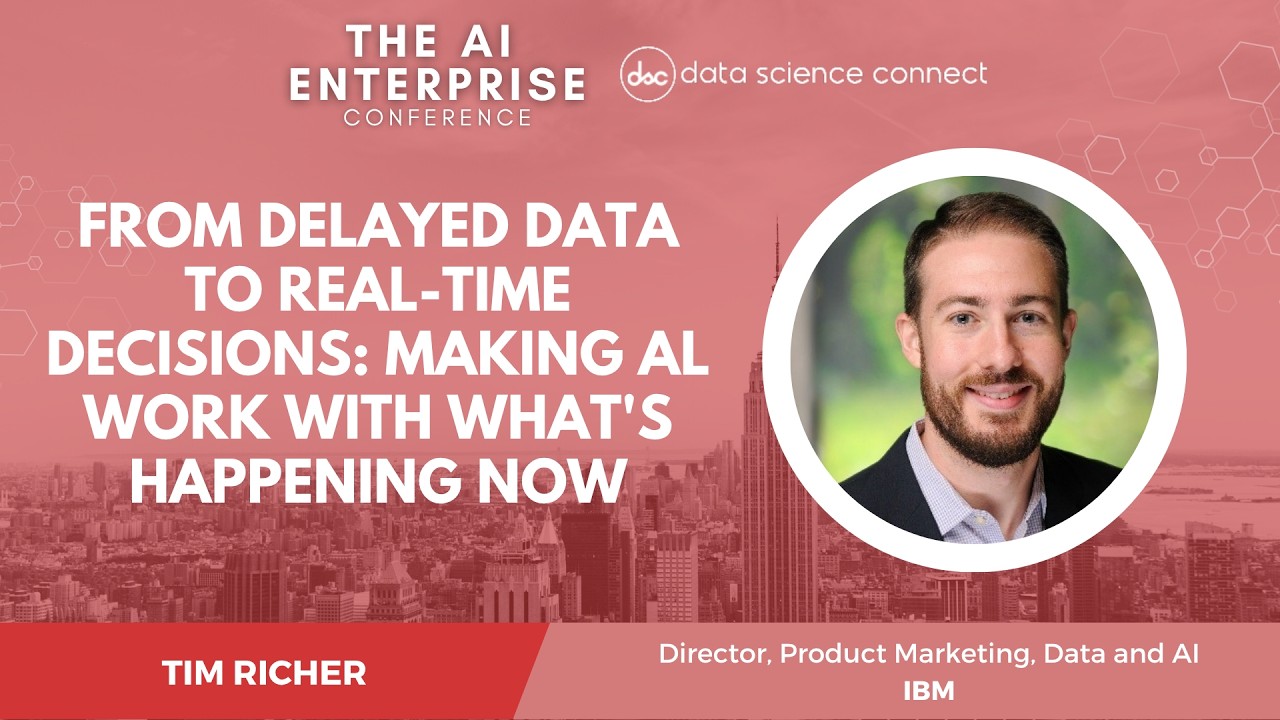
At The AI Enterprise Conference 2026, IBM's Tim Richer said fragmented systems, stale data and reactive governance hold back most AI projects. He shared the use cases scaling fastest, how IBM runs agents on its own HR, IT and procurement systems, and client results from Ferrari and EY.
Key takeaways
- Three problems recur. Richer said every project faces fragmented operations, stale data without context, and governance and security pressure.
- Three use cases lead. Customer service, employee productivity and IT operations are where IBM sees the most value.
- IBM is its own first client. Its Ask IBM agentic layer runs HR, IT, sales and procurement agents for a 250,000-person company.
- Don't centralize everything. Richer recommended serving agents data in real time where it lives rather than moving it.
- Start with value. IBM often opens engagements with a five-year business value assessment.
AI agents are only as useful as the data they act on, and in most enterprises that data is stale, scattered and missing business context. That was the message from Tim Richer, who leads product marketing for IBM's data and AI business, in a session at The AI Enterprise Conference 2026 in New York City on moving from delayed data to real-time decisions.
Richer drew on what he described as thousands of IBM client projects, from pilots to global deployments, and on IBM's own internal AI rollout.
What holds back enterprise AI projects?
Richer said three problems show up in some form in every project IBM works on.
The first is fragmentation and strained operations. Large organizations run hundreds or thousands of applications, including CRM and ERP systems, across multiple clouds, on-premises environments and edge devices, all while under pressure on cost.
The second is data. "It's around stale data and data without context," Richer said. Every project, he said, involves some element of data quality, data context and connecting business meaning to data in real time.
The third is governance and security. Companies are trying to manage data governance, AI governance and data security proactively rather than reactively, to avoid data leaks, AI security breaches and the financial and brand risk that follow. The stakes rise with geography, Richer said, noting that IBM's European clients face more regulation and privacy requirements than U.S. clients.
Most organizations know broadly what data they need to feed agentic systems, he added. The problem is that the knowledge is dispersed across enterprise software, cloud data platforms such as Snowflake and Databricks, and a growing mix of commercial and open-source models.
Which AI use cases are delivering value at scale?
Richer grouped the use cases IBM sees most often into three broad categories:
- Customer service: not just chatbots, but digital and fan experiences, personalized marketing campaigns at scale, and agent-assist tools that help human representatives have better conversations with customers
- Employee productivity, or digital labor: manual, paper-based, process-driven work in finance, supply chain, procurement and especially human resources
- IT operations: software development and application modernization, where Richer said teams using tools such as Codex, Cursor or IBM's own Bob are generating 60% to 90% of code and refocusing engineers on integration and modernization work
How does IBM use AI internally?
IBM treats itself as "client zero," Richer said. "We actually treat ourselves as the first client," he explained, because a company with 250,000 employees, operations in every country a U.S. company can work in, and a mix of old systems, new systems and acquisitions has likely run into most integration problems its clients face.
Internally, IBM built an agentic layer called Ask IBM on top of a common data layer that pulls from its clouds, ERPs, CRMs and applications. Domain-specific agents sit on top. An HR agent built over IBM's SAP HR systems lets managers retrieve records and promote or transfer employees with a prompt, and Richer said almost every employee now uses it instead of the underlying HR system. Other agents handle IT service tickets, sales on top of IBM's Salesforce instance, and procurement.
Richer said IBM has been able to report $5.5 billion in annualized savings, figures he said are audited by its public auditors.
What do real-time AI use cases look like for clients?
Richer highlighted two client examples. Ferrari, which he said has about 380 million fans worldwide, worked with IBM on an app that serves fans real-time race-day data and analytics. Under the hood, it connects data across an AWS environment and a Salesforce instance holding customer data. Richer said the app has increased both its number of users and the time fans spend in it.
Ernst & Young applied AI to first-pass invoicing in tax work, which involves structured and unstructured data from dozens of sources and file types. Richer said EY has achieved more than 95% on first-pass invoices, freeing accountants to focus on the final steps.
How should enterprises structure data for agentic AI?
Richer described IBM's approach as an AI operating model with four layers: agentic workflows for building and orchestrating agents wherever they run; an intelligent data layer that is real time, trusted and governed; hybrid operations covering application automation, resiliency and security; and hybrid infrastructure spanning cloud, on-premises systems and mainframes.
On data, his advice ran against centralization. "We generally do not recommend needing to move data into centralized places," he said, favoring access to data where it lives and serving it to agents in real time. He pointed to IBM's acquisition of Confluent, announced earlier in the year, which he said is now the center of IBM's streaming strategy. Confluent was created by the founders of Apache Kafka.
As a starting point, Richer said IBM often begins engagements with a five-year business value assessment. "We tend to begin with thinking of business value," he said.
More enterprise AI case studies in 2027
Real-time data and the infrastructure behind agentic AI were recurring topics at The AI Enterprise Conference 2026. The 2027 conference takes place Tuesday, August 31, 2027, at Pier Sixty in New York City, with registration coming soon. Data Science Connect also hosts free webinars on data and AI infrastructure throughout the year.
Frequently asked questions
Why does real-time data matter for AI agents?
Richer said stale data and data without business context are among the most common problems in AI projects, because agents need current, trusted data to act with confidence.
What is IBM's client zero approach?
IBM tests its technology on itself first. Richer said its internal Ask IBM agentic layer sits on a common data layer and supports HR, IT, sales and procurement agents.
Which enterprise AI use cases scale best?
According to Richer, customer service, employee productivity or digital labor, and IT operations such as software development and application modernization.
Do companies need to centralize data for AI?
Richer said IBM generally doesn't recommend it, favoring access to data where it lives in a hybrid environment, served to agents in real time.
Watch: From Delayed Data to Real-Time Decisions: Making Al Work with What's Happening Now on YouTube
Event: The AI Enterprise Conference · More coverage: The AI Enterprise Conference insights