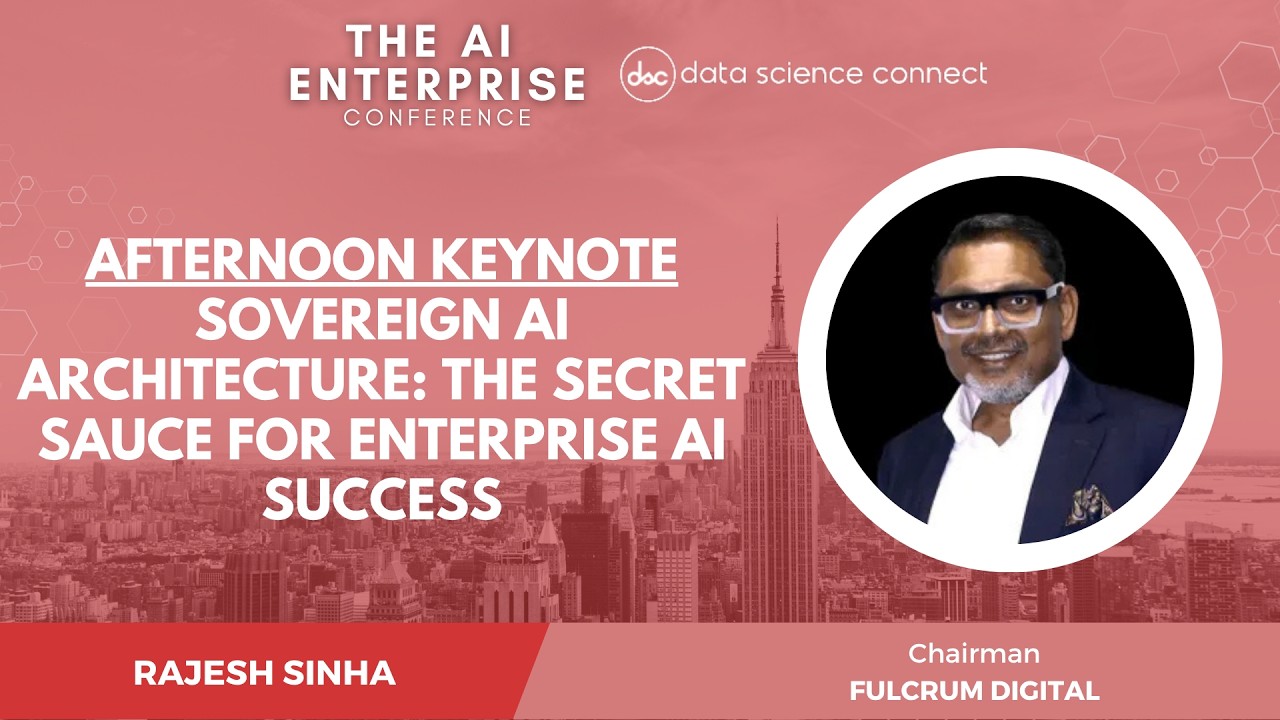
At The AI Enterprise Conference 2026, Fulcrum Digital founder Rajesh Sinha said enterprise AI has moved from an era of speed to an era of control. He laid out a seven-layer sovereign AI architecture, explained why many projects fail at the inference layer, and shared agent use cases from insurance, finance and manufacturing.
Key takeaways
- Control matters more than speed. Sinha said enterprise AI is now in an era of control, not fast adoption.
- Sovereignty keeps AI inside the firewall. Global banks and payment companies often need data to stay in-country and on their own premises.
- Two pillars span every layer: security and governance for the CISO, and observability and cost control for the CFO.
- Inference routing is where projects fail. Sending each task to the right model and agent keeps results accurate and costs down.
- Own your agent observability. Sinha advised building a vendor-agnostic control panel for latency, model use and agent activity.
For enterprises moving AI agents into production, the challenge has shifted from adopting AI quickly to controlling it, according to Rajesh Sinha, founder of Fulcrum Digital. In an afternoon keynote at The AI Enterprise Conference 2026 in New York City, Sinha walked through the seven-layer sovereign AI architecture his AI and digital engineering firm uses with banks, payment companies, insurers and manufacturers.
Sinha framed the talk around golf. Good form takes practice and control, he said, and AI is no different. "It's the era of control AI," he said. "It's not speed. It's control."
What is sovereign AI architecture?
Sinha's clients include global banks and payment companies that operate in many countries. Many of those countries require data to stay within their borders, and corporate governance often requires systems to run on the company's own premises. That calls for a sovereign data architecture, he said, in which "everything we are talking today is going to be inside your firewall."
Two pillars run across all seven layers of Fulcrum's architecture: security and governance, and observability and control. Sinha tied each pillar to an executive. The CISO needs security to be confident in running AI, and the CFO needs control over token usage and the value AI creates. "If CFO is happy, CISO is happy, you're running a great AI production journey," he said.
On security, Sinha described an audit trail of everyone who accesses any system at any layer, and a bias layer that flags whether AI output is acceptable before it reaches validation.
What are the seven layers of a production AI architecture?
Sinha described the stack from the bottom up:
- Sovereign compute: infrastructure that keeps data and processing inside the firewall
- Data platform: enterprise data organized so it can be vectorized and fed to LLMs, with a context layer over siloed systems
- Model layer: frontier and open-weight models, orchestrated by which is best for each task
- Inference and serving: routing each request to the right model and agent based on business intent
- Workflow orchestration: RAG, advanced RAG and micro agents working together on an industry's specific workflows
- Agent fabric: a company-wide intelligence layer on which many agents can be built
- Consumption: delivering agents into the applications people use
Most of the industry has matured at the model layer, he said. The inference layer is where many projects fail.
Why do AI projects fail at the inference layer?
When projects reach production, Sinha said, business users often reject them because the results aren't what they expected. The fix is routing logic that sends each task to the right model. He compared using an expensive model for a simple task to driving a Ferrari to the grocery store. Simple tasks still need accurate answers, and complex tasks need more capable models.
He gave an example from a life insurance sales assistant Fulcrum built. An AI agent listened to conversations between agents and prospective buyers, pulled collateral from Salesforce, SharePoint, the product catalog and policy administration systems, and suggested what the salesperson had missed. It also had to handle objections, work in several languages and respond in real time.
The business rejected the first release, Sinha said, and after a second demo still objected to delays in the voice responses. Combining micro agents at the workflow layer solved those problems, and the tool was eventually approved for production.
How should enterprises monitor hundreds of AI agents?
Companies rolling out hundreds of agents need an observability view that shows each agent's latency, time spent, which LLM it uses and what problem it is solving, Sinha said. He called it "a complete x-ray report of your enterprise AI" and said it gives executives the trust they need.
He cautioned against relying on vendors for it. Every vendor will claim to have a control panel, he said. "Have your own control panel, which is vendor agnostic."
What other enterprise AI agent use cases did Fulcrum share?
Sinha described several other agents:
- Invoice processing for manufacturing, retail and packaging companies, reconciling invoices that arrive in different formats and are interpreted differently by SAP and finance teams
- A customer service invoicing agent that answers incoming calls, reads the finance system and tells callers their invoice number and amount
- An underwriting workbench that extracts and analyzes broker submissions, automatically generates quotes for approved risks and routes high-risk cases to human underwriters
- A 13-agent software development life cycle covering requirements, architecture, database design, user experience, development, SRE and documentation
Sinha said vibe coding alone can't compress the software development life cycle, because every step is still needed for quality, production-ready systems. He closed with a line from Fulcrum's chief AI officer: enterprises "that treat AI as a platform decision, not a project decision, will be the one still standing in 2030."
Hear more on production AI architecture in 2027
Architecture talks from enterprise AI practitioners are a staple of The AI Enterprise Conference, which returns to Pier Sixty in New York City on Tuesday, August 31, 2027. Registration is coming soon on the conference page. Between conferences, Data Science Connect hosts 24 free live webinars on its 2027 schedule.
Frequently asked questions
What is sovereign AI architecture?
As Sinha described it, an AI architecture that keeps data, models and processing inside a company's firewall and within required geographic borders, with security and observability built into every layer.
Why do enterprise AI projects fail in production?
Sinha said many fail at the inference layer, when business users reject results because requests aren't routed to the right model and agent for the task.
What should an AI agent observability dashboard show?
Each agent's latency, time spent, which LLM it uses and what problem it is solving, according to Sinha.
Should enterprises use vendor AI control panels?
Sinha advised building your own vendor-agnostic control panel rather than depending on each vendor's.
Watch: Keynote: Sovereign AI Architecture: The Secret Sauce for Enterprise AI Success on YouTube
Event: The AI Enterprise Conference · More coverage: The AI Enterprise Conference insights