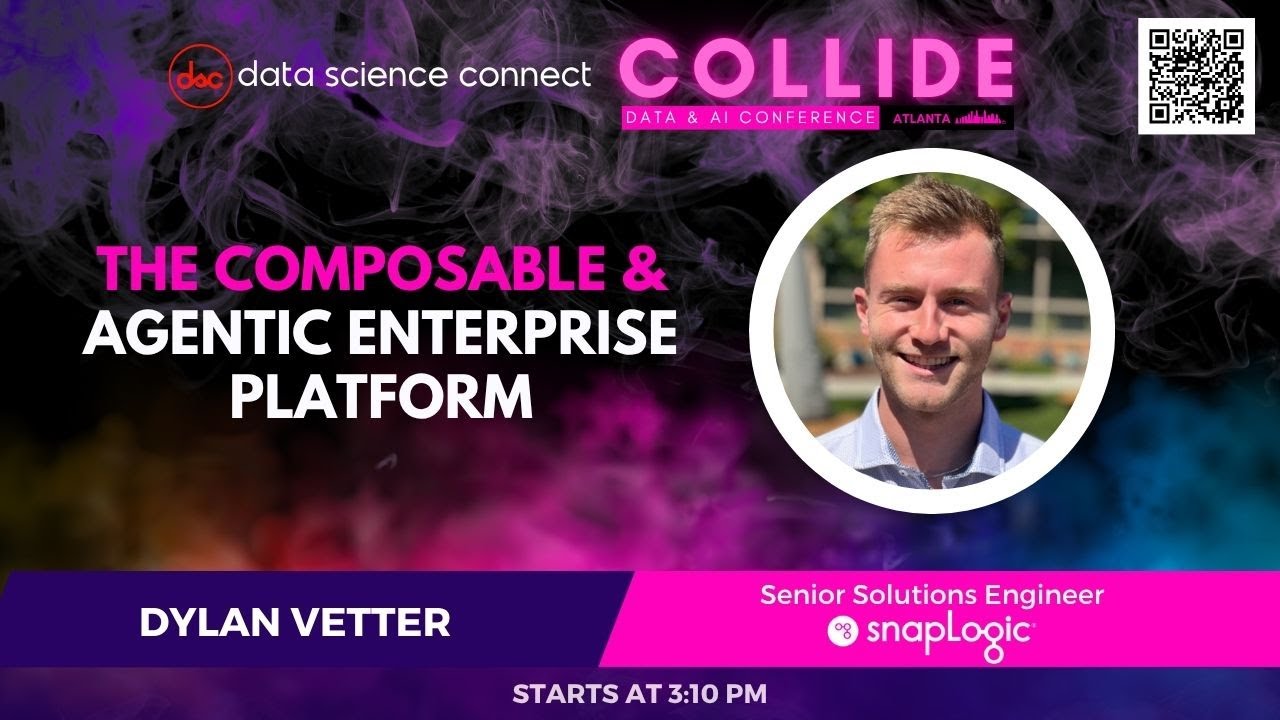
At COLLIDE 2025, SnapLogic Senior Solutions Engineer Dylan Vetter argued that no one is closer to enterprise data than the integration platform. He explained how IT teams can share governed integration assets across business units and build custom MCP servers that connect LLMs to company data.
Key takeaways
- Four hurdles recur. Vetter sees democratization, composability, AI readiness and digital experience across companies of every size.
- Integration sits closest to the data. That makes it the natural place to cleanse, enrich and govern data before AI uses it.
- IT owns, business units consume. A governed marketplace of templates, pipelines, APIs and agents spreads integration without point-to-point sprawl.
- Build MCP servers on data you already access. Vetter said custom servers avoid buying one per application and let teams expose only the functions they want.
- Expect disruption. Vetter predicted vendors will start charging for APIs and that on-demand reporting in LLM tools will change analytics.
Integration platforms are becoming the data layer for enterprise AI agents, SnapLogic Senior Solutions Engineer Dylan Vetter told attendees at COLLIDE Data + AI Conference 2025 in Atlanta, in a session sponsored by SnapLogic. Vetter described how SnapLogic, long known as an integration company, now positions itself as a composable, agentic platform that feeds the generative AI solutions enterprises build.
Drawing on five years in the integration space, working with large companies such as Workday, Adobe and Palo Alto as well as small businesses, Vetter outlined the hurdles he sees most often and how AI is changing the role of integration.
What are the most common enterprise integration hurdles?
Vetter named four. The first is democratization, letting users outside the core IT group build integrations. It sounds like a good idea, he said, but if everyone builds their own, after 12 months a company ends up with overlapping point-to-point integrations, security holes and no governance. Getting it right requires a balance of governance, speed and control.
The second is the composable enterprise: templatizing integrations or turning them into microservices so that teams can reuse what they built as they scale. The third is AI readiness, which Vetter said would not have been on his slide three years ago and may now be the top priority in his customer meetings. The fourth is digital experience, exposing data and services to outside partners through webhooks, APIs or B2B integrations.
Why does integration matter for AI readiness?
Integration and AI may seem like separate disciplines, Vetter said, but they are closely intertwined. "There's no one closer to the data than your integration platform," he said. A platform that can cleanse data and enforce quality, security and governance before AI acts on it is "extremely important."
He described what he called augmented intelligence, which he said is really a fancy term for data readiness. Raw data, such as point-of-sale records in retail, is cleansed and enriched with classification tags and behavioral trends, then stored wherever the customer chooses. Often that starts with analytics rather than generative AI. But analysts still need time to build reports and may depend on other teams for more data, which is where agents come in, Vetter said.
According to Vetter, SnapLogic builds data sets in memory at runtime as data moves through the platform. "SnapLogic does not store or cache any of this data," he said. Data integration, application integration, API management and AI workloads all run on one design and runtime, which he contrasted with competitors that assembled their platforms through acquisitions.
How can IT teams democratize integration without losing control?
Even with a low-code platform, Vetter said, the core IT team often remains a bottleneck because it is the only group building integrations. His recommended model is for IT to own the platform and publish a marketplace of assets, including integration templates, pipelines, APIs and agents, built on its best practices.
Business units can then use those assets as they are, extend them, or expose them to vendors and customers, while IT keeps governance over the underlying processes. Vetter said financial companies in particular use this structure to run chargeback models that track which business unit is using more data.
How do custom MCP servers connect LLMs to enterprise data?
Public chatbots can answer general questions, Vetter said, but ask about a company's top campaigns or sales opportunities and they lack the data and may hallucinate. Model Context Protocol (MCP) creates a tunnel between large language model clients and back-end data, he said.
Because SnapLogic already connects to many applications, Vetter said customers can create custom MCP servers on any data they can access, governed by the platform's security and access controls. "Now you don't have to wait for Salesforce to come out with their MCP server," he said. With 80 or 90 applications in a typical organization, he argued, buying a separate MCP server for each raises cost, scalability and inconsistent-security concerns.
He shared an example from an unnamed company that wanted a Jira MCP server without exposing all of Jira's functions. It built its own server limited to four or five capabilities: searching Jira, creating tickets, adding comments and updating tickets. The server was exposed as a URL that other business units could consume. Buying a full vendor server, Vetter said, can mean "opening Pandora's box."
Will MCP disrupt APIs and analytics?
In Q&A, Vetter said SnapLogic does not have to be the source of all data. A customer that already uses Snowflake's or GitHub's MCP server can connect to it through an MCP client. "SnapLogic doesn't need to be a hero," he said.
Asked about the future, he offered what he called his own opinion: "I think people are going to start charging for APIs," as more organizations build their own MCP servers on application data. He also predicted disruption in analytics. Tools such as Tableau and Power BI will still be needed and will evolve, he said, but generating reports on demand in tools like Claude and Gemini, once they have access to the data, is a major shift.
Hear more on agentic AI at COLLIDE 2027
COLLIDE, the largest AI conference in the Southern U.S., brings more than 1,000 enterprise data and AI leaders to Atlanta for keynotes, panels and technical sessions like this one. The 2027 conference takes place Wednesday, October 13, 2027, at the Sandy Springs Performing Arts Center. Details are at COLLIDE, and Data Science Connect also runs free live webinars on agentic AI throughout the year.
Frequently asked questions
What is a composable enterprise in integration?
Vetter described it as templatizing integrations or turning them into microservices so teams can reuse past work as the number of integrations grows.
What is an MCP server used for?
Model Context Protocol servers connect large language model clients to back-end data, so an LLM can answer questions about company information such as campaigns or sales opportunities.
Why build a custom MCP server instead of buying one?
Vetter said a custom server can expose only selected functions, such as searching and updating Jira tickets, and avoids buying separate servers for dozens of applications.
How can companies democratize integration without sprawl?
Vetter recommended that core IT own the platform and publish governed reusable assets that business units can use, extend or expose to partners.
Watch: The Composable & Agentic Enterprise Platform on YouTube
Event: COLLIDE AI Conference · More coverage: COLLIDE AI Conference insights