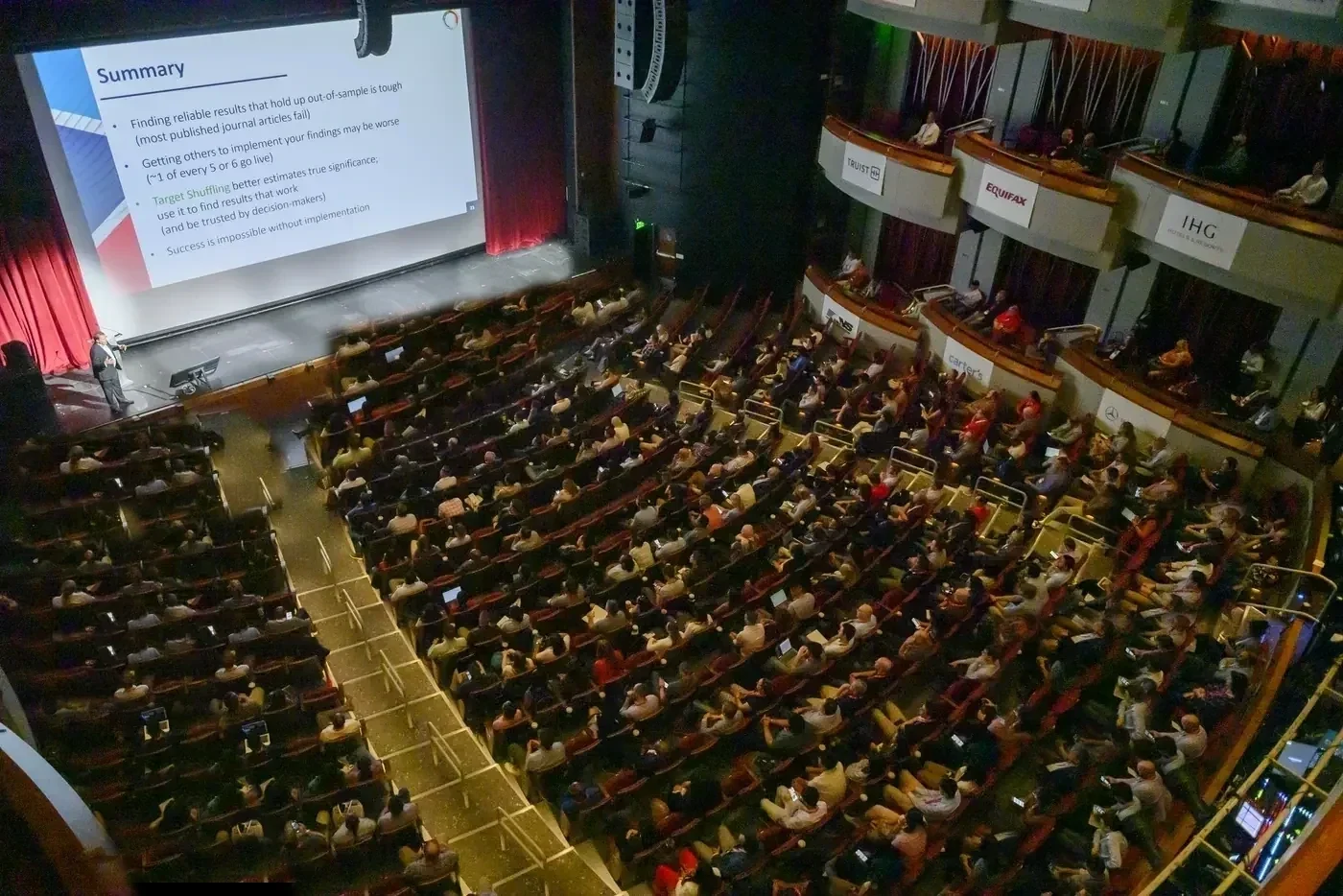
Banks and payment companies have about 50 milliseconds to approve or block a card transaction. At COLLIDE 2025, Aerospike Chief Evangelist Sesh Seshadri explained how machine learning, graph analytics and multi-stage inference fit into that window, and why database speed determines how much AI each decision can use.
Key takeaways
- The window is about 50 milliseconds to decide on a point-of-sale or online card transaction.
- Tail latency matters as much as averages. Moving detection from 98.5% to 99.9% makes a large financial difference.
- Fraud detection has evolved from static rules to machine learning to real-time graph analytics.
- Multi-stage inference saves the most complex models for the riskiest roughly 10% of transactions.
- Faster feature lookups leave models more time and data for each decision.
Financial fraud is an arms race, Aerospike Chief Evangelist Sesh Seshadri told attendees at COLLIDE Data + AI Conference 2025 in Atlanta, in a session sponsored by Aerospike. Estimates of annual fraud losses range from $1 trillion to $10 trillion, and fraudsters are now using automation and AI themselves.
In that environment, Seshadri said, "milliseconds probably are going to determine millions."
Why is real-time fraud detection so difficult?
Fraud teams face a paradox, Seshadri said. Legitimate customers expect a smooth experience and shouldn't be wrongly declined, yet no fraudulent transaction can get through. Whoever solves that at low latency gains a competitive advantage, he said.
Detection has to happen inline, as the transaction occurs, not after the fact. A card swipe or online checkout typically leaves about 50 milliseconds for a decision. Even catching 99% of fraud isn't enough when the remaining 1% adds up to large losses.
How has fraud detection technology evolved?
Seshadri described five stages of fraud detection maturity:
- Static data and intuition about risky businesses or behaviors
- Rules, such as five card swipes in five minutes or a purchase in an unusual location. He said the list of rules never ends, like plugging a dam with duct tape.
- Machine learning, which combines hundreds of features, learns the best decision boundaries, reduces both false positives and false negatives, and surfaces new fraud patterns
- Graph analytics, which exposes money mules, fraud rings and collusion that look harmless one transaction at a time
- Real-time graph, which can catch multi-hop money laundering as it unfolds, even though model training takes 15 minutes to hours
Machine learning with real-time graph capabilities on top is "the cutting edge of how you detect fraud today," Seshadri said.
How does multi-stage fraud inference work?
Models perform better with more data and more complexity, but no system can run its best model on every transaction within 50 milliseconds. Leading teams split inference into stages, Seshadri said:
- Under 1 millisecond: a simple rules-inspired model, such as logistic regression, clears about 70% of transactions, like a recurring monthly utility autopay.
- About 5 milliseconds: a model of intermediate complexity handles about 20%, such as a slightly larger purchase at a new store in the customer's usual neighborhood.
- About 15 milliseconds: the most sophisticated analysis is saved for unusual activity that deserves a closer look.
Each stage requires a feature lookup. If lookups are slow, the time budget runs out early, Seshadri said. If they take about a millisecond, models get more steps and more data within the same window. He shared one customer's description of the benefit: "It allows us to do more complex risk calculations in less time."
What role does the database play in AI fraud detection?
In a typical setup, batch data such as partner records and credit information feeds model training, while live transactions are ingested as they happen. At decision time, the inference engine checks whether it already has an answer, pulls the latest features, computes new ones if needed, and returns a decision.
Seshadri said Aerospike can serve as the online feature store, state store and inference cache in that architecture. "We are probably the first database you'll meet when a customer transaction comes from the internet," he said.
He cited fraud deployments at PayPal and TransUnion, and server-footprint reductions of 70% to 80% at Grab and LexisNexis, which he attributed to Aerospike's patented hybrid memory architecture. He also described a core-and-edge design, in which features generated centrally are pushed to edge clusters close to where transactions happen.
During Q&A, Seshadri said Aerospike doesn't train models. Customers train their own and load the resulting features into the database. Data typically moves in and out through tools such as Kafka. Customers can run Aerospike on their own premises or as a hosted service.
See sessions like this at COLLIDE 2027
COLLIDE, the largest AI conference in the Southern U.S., brings more than 1,000 enterprise data and AI leaders to Atlanta for a day of keynotes, panels and technical sessions like this one. The 2027 conference takes place Wednesday, October 13, 2027, at the Sandy Springs Performing Arts Center. For more on real-time AI between conferences, catch Data Science Connect's free live webinars.
Frequently asked questions
How fast does fraud detection need to be?
Card and online transactions typically allow about 50 milliseconds for a fraud decision, according to Seshadri.
What is multi-stage inference in fraud detection?
An approach in which simple, fast models clear most low-risk transactions and more complex models are reserved for the smaller share of unusual ones.
Why is graph analytics used for fraud detection?
Much fraud happens through networks of mules, rings and colluding accounts. Graph analysis exposes connections that individual transactions don't reveal.
What is tail latency and why does it matter for fraud?
Tail latency is how long the slowest responses in a system take. In fraud detection, slow outliers can let fraudulent transactions through or degrade the customer experience.
Watch: Fighting Financial Fraud in Real Time with AI on YouTube
Event: COLLIDE AI Conference · More coverage: COLLIDE AI Conference insights