
In a Data Science Connect GenAI Demo Day, three vendors ran 10-minute live demos. Snowflake showed Cortex Agents across structured and unstructured data, TiDB built a knowledge graph for GraphRAG inside one database, and Zenlytic answered an open-ended marketing question with governed metrics.
Key takeaways
- Agents need governed access. Snowflake's Cortex Agents route questions to Cortex Analyst for SQL and Cortex Search for unstructured data, inside existing access controls.
- Agents ship as APIs. Cha-Earley showed an agent answering data and document questions from a Microsoft Teams chat via REST API.
- GraphRAG in one store. TiDB keeps relational, vector and graph data together, extracting entities and relationships automatically from documents.
- Shared definitions prevent conflicting numbers. Zenlytic's Zoe uses the same metric calculations as dashboards.
- Open-ended questions are the harder test. Blankley showed Zoe turning a vague marketing request into a channel and campaign budget recommendation.
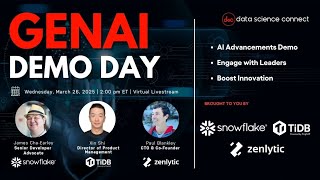
Three vendors showed how generative AI can retrieve and reason over enterprise data in a Data Science Connect GenAI Demo Day webinar hosted by Brian Mink, co-founder and president of Data Science Connect. Each company had about 10 minutes for a live demo: James Cha-Earley, senior developer advocate at Snowflake; Xin Shi, director of product management for TiDB at PingCAP; and Paul Blankley, CTO and co-founder of Zenlytic.
The session was brought to you by Snowflake, TiDB and Zenlytic. Here is what each demonstrated.
How do Snowflake Cortex Agents work across structured and unstructured data?
Cha-Earley presented Cortex Agents, which he described as data agents that answer questions across both tables and unstructured content such as text, audio and video. Snowflake believes AI agents will soon be essential to the enterprise workforce, in areas such as customer support, field service, analytics and engineering, he said.
He stressed that agents only work at scale if they reach enterprise data while following existing security and governance policies. In Snowflake's design, governed data sits inside its security perimeter with role-based access controls. Unstructured data is pre-processed with Cortex functions such as sentiment and summarization so agents get meaningful information instead of raw chunks.
Two retrieval tools do the work. Cortex Analyst generates SQL against structured data, and Cortex Search pulls insights from unstructured data. An agent plans, splits a question into smaller tasks, routes them to the right tool, reflects on interim results and decides the next step. Cha-Earley said Cortex Analyst has out-of-the-box accuracy of 90% and that agents are available as REST APIs, so they can be embedded in Streamlit apps, Slack, Microsoft Teams or websites.
In a demo run from a Microsoft Teams chat, he asked an agent to break down customer service tickets by service type, count customers with a given ticket type and contact preference, and explain payment terms from a set of PDFs, with a link back to the source document. Looking ahead, he said Snowflake believes agents "have a potential to reduce both software and labor expenses by orders of magnitude."
What is GraphRAG, and how does TiDB support it in one database?
Shi said the company believes "every business will become a data plus AI business." Shi described TiDB as a SQL-compatible, horizontally scalable, open-source database with automatic sharding.
The demo focused on GraphRAG, or knowledge-graph retrieval, which Shi called the de facto design pattern for intelligent applications that combine vector and graph-based retrieval. Most teams build it on separate databases for vectors, graphs, relational data and documents, which leads to duplication, operational complexity and higher cost, according to Shi. Building a quality knowledge graph is also hard because traditional approaches require defining entities and schemas up front.
TiDB's approach puts relational, unstructured, graph and vector data in one system. In a notebook demo, Shi used the TiDB SDK to load markdown files from TiDB's documentation. The system chunked the text, stored embeddings and automatically extracted entities and the relationships between them into three tables: entities, relationships and chunks, each with vector columns. Shi then ran a similarity search over the chunks and a graph search showing how related components connect, both of which can be passed to an LLM for a better answer.
Shi said retrieval is modeled on how people think: decompose the question, explore the stored graph, optimize the query, then evaluate, rerank and filter results. Shi said customers have seen graph construction up to 80% cheaper than traditional approaches. Internal uses include a chatbot in TiDB's Discord server, a support-ticket assistant, a text-to-SQL assistant in TiDB Cloud that can also fix failing queries, and an index advisor that flags slow, resource-heavy queries.
How does Zenlytic answer open-ended business questions?
Blankley described Zenlytic as an intelligent analytics product that answers business questions, "not just something that sounds very much like a SQL query."
Using voice input, he asked Zenlytic's assistant, Zoe, to compare year-to-date gross revenue with the prior year by product type. Zoe drew on the organization's metric definitions, and users can hover over any element to see how it is calculated. Because the same calculations feed dashboards, users don't get one number from the AI and another from a report, he said. He could also switch from gross to net revenue with a click. "It's actually a lot faster for me just to click on this," he said.
His second scenario was open-ended. Playing a newly hired marketing manager with a meeting with the CMO in minutes, he asked Zoe what data existed to measure campaigns and channels. Zoe listed available metrics such as return on ad spend and customer acquisition cost, then identified the best-performing channel, drilled into its campaigns, and wrote a summary recommending where to shift budget. Zoe could also save the results to a dashboard scheduled for weekly delivery.
Asked about deployment, Blankley said it is iterative. Teams select warehouse tables, start asking questions, and correct definitions Zoe guesses, such as how gross revenue is calculated. Zoe then reuses the saved definition.
See more live AI demos in 2027
Demo days like this one are part of Data Science Connect's free webinar program. The 2027 schedule includes 24 live webinars across four series, including AI Demo Days and Agentic AI Showcases, alongside the AI × Enterprise Panel Series and the Plug & Play Series. Registration for 2027 is coming soon.
Frequently asked questions
What are Snowflake Cortex Agents?
Agents that plan and route questions to Cortex Analyst, which writes SQL for structured data, and Cortex Search, which retrieves from unstructured data, available as REST APIs.
What is GraphRAG?
A retrieval pattern that combines vector search with a knowledge graph of entities and relationships, so an LLM gets both relevant text and how concepts connect.
Can a single database support GraphRAG?
Shi said TiDB stores relational, vector and graph data in one system using three tables (entities, relationships and chunks) with vector columns.
How does Zenlytic avoid wrong AI analytics answers?
Blankley said Zoe uses governed metric definitions that users can inspect, the same ones used in dashboards, and that teams refine over time.
Watch: GenAI Demo Day: Cutting-Edge AI Solutions in Action! | Live Demos & Insights on YouTube
Event: Webinars · More coverage: Webinars insights