





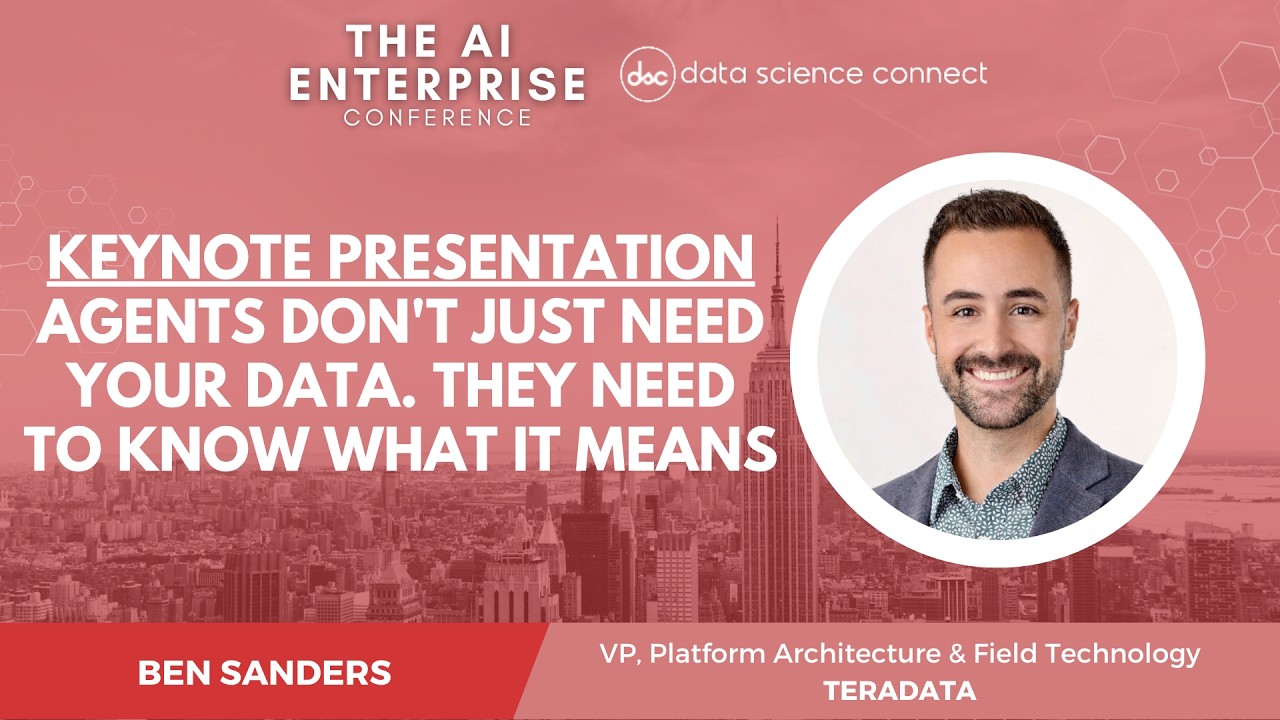
Data lakes and lakehouses were built for human users, not agents that run around the clock and scale to thousands, Teradata's Ben Sanders said at The AI Enterprise Conference 2026. He explained why pilots break in production, how missing context drives up cost and latency, and the six components of enterprise context.
Key takeaways
- Data lakes were built for humans. Agents run 24 hours a day, scale quickly and lack the context analysts and DBAs carry.
- Pilots skip production rules. Ignoring SLAs, governance and audit needs in a POC causes failure at scale, Sanders said.
- The bottleneck has moved up the stack. A 2-millisecond query is slow if the LLM spends 8 minutes reasoning first.
- Context goes beyond semantics. Sanders listed industry semantics, institutional knowledge, data products, agent skills, built-in governance and context management.
- Reuse context across agents. Rebuilding definitions for every pilot doesn't scale.
"Your data lakes and lake houses are not good enough," Ben Sanders of Teradata told attendees at the start of his keynote at The AI Enterprise Conference 2026 in New York City. It wasn't a criticism of the teams that built them, he said, but a reflection of how much the industry has shifted.
In "Agents Don't Just Need Your Data. They Need to Know What It Means," Sanders drew on conversations with Teradata customers to explain why AI agents struggle with enterprise data and what context they need to deliver ROI beyond a demo.
Why aren't data lakes ready for AI agents?
The data lakes and lakehouses companies have built over the past five or six years were designed for human usage patterns, Sanders said. People work during the day and go home at night. "Agents don't sleep. Agents run 24 hours a day," he said, and they can scale from one agent to 100,000 very quickly.
Human users also bring context that agents lack. Business analysts and DBAs know what the data means and how to use it. An LLM arriving at the same data doesn't, Sanders said, so the question is how to embed that context in the platform itself.
He asked the room who would feel comfortable building a new agent, without a human in the loop, for their most critical business problems. No hands went up. That, he said, says more than any analyst statistic about where enterprise AI ROI stands.
Why do AI pilots fall apart in production?
Pressure from boards and leadership to move quickly leads teams to build pilots that ignore production rules such as SLAs, data governance and regulatory or audit requirements, Sanders said. The pilot shows value, then breaks on cost or governance when it scales from one user to 100,000 agents.
Models keep improving every quarter, yet analysts' assessments of AI ROI have stayed largely flat, he said. His conclusion: "the ROI from AI doesn't come from the models." The gap is context.
How do AI agents drive up cost and latency?
Sanders described three problems customers raise as they move from AI as an assistant to AI as an operator that makes decisions and works with other agents.
- The bottleneck has moved up the stack. A query may run in 2 milliseconds, but if an LLM spends 8 minutes reasoning first, "that query took 8 minutes and 2 milliseconds." Performance now depends on helping the LLM find the right path sooner and avoid costly retries.
- Tokenomics. Without the right context, agents try many tool calls through an MCP server before landing on the right one, and teams load too much context into every session. Sanders said he runs through his own internal token allotment within about a week.
- Using the wrong tools. Many business processes can run on simpler, cheaper tools at the bottom of what he called the AI toolbox, rather than general LLM reasoning at the top. "If you allow an LLM to make that decision, it's going to pull all the data out and process it at the top level," he said.
What context do enterprise AI agents need?
At Teradata, Sanders said, context means more than a semantic layer or ontology. It means capturing the knowledge DBAs and business analysts apply to data today and embedding it in the platform agents use. Without that, teams map data definitions by hand for every pilot. "We're recreating context every single time, which is not efficient and it doesn't scale," he said.
He listed six components:
- Semantic understanding mapped to the details of a specific industry
- Institutional knowledge, such as how workflows run inside the organization and information shared over email
- AI-ready data products, such as a customer lifetime value product reused from one agent to the next
- Agent skills and tools that teach an LLM to use platform features correctly and efficiently
- Governance built into the platform, so rules about how data can be used apply automatically instead of being negotiated project by project
- Efficient context management, a reasoning layer that loads only the context relevant to a given task
What is Teradata building for agentic AI?
Sanders described what Teradata calls a knowledge platform: its existing data platform, with a context layer and agent tools for creation, monitoring and governance on top. He said a Teradata context engine was due to launch soon after the conference. As he described it, the engine ingests metadata from multiple data stores, maps it to Teradata's industry data models and a customer's own models, and adds organizational knowledge from documents and email.
It also includes operational memory, he said. If a human overrides an agent's decision, that override is stored as context so the next agent doing the same task sees the new workflow. That, according to Sanders, is how companies move from point solutions to enterprise solutions.
The goal, he said, is that the next time he asks a room who is confident putting an agent on their most critical business questions, more than zero hands go up.
Explore AI context and data strategy in 2027
Context engineering and data readiness for agents are central themes at The AI Enterprise Conference, which returns to Pier Sixty in New York City on Tuesday, August 31, 2027. Registration is coming soon on the conference page. Data Science Connect's free webinars, 24 of them on the 2027 schedule, also cover agentic AI and data infrastructure.
Frequently asked questions
Why aren't data lakes ready for AI agents?
Sanders said they were designed for human usage patterns, while agents run continuously, scale to many instances and lack the business context human users bring.
What context do AI agents need to work with enterprise data?
According to Sanders: semantic understanding mapped to the industry, institutional knowledge, AI-ready data products, agent skills and tools, governance built into the platform, and efficient context management.
Why do AI agents use so many tokens?
Without the right context, agents try many tool calls before finding the right path, and teams load too much context into each session, Sanders said.
Does better AI ROI come from better models?
Sanders argued it doesn't. Models improve every quarter while ROI has stayed largely flat, and he said the real gap is context.
Watch: Keynote Presentation: Agents Don't Just Need Your Data. They Need to Know What It Means on YouTube
Event: The AI Enterprise Conference · More coverage: The AI Enterprise Conference insights


