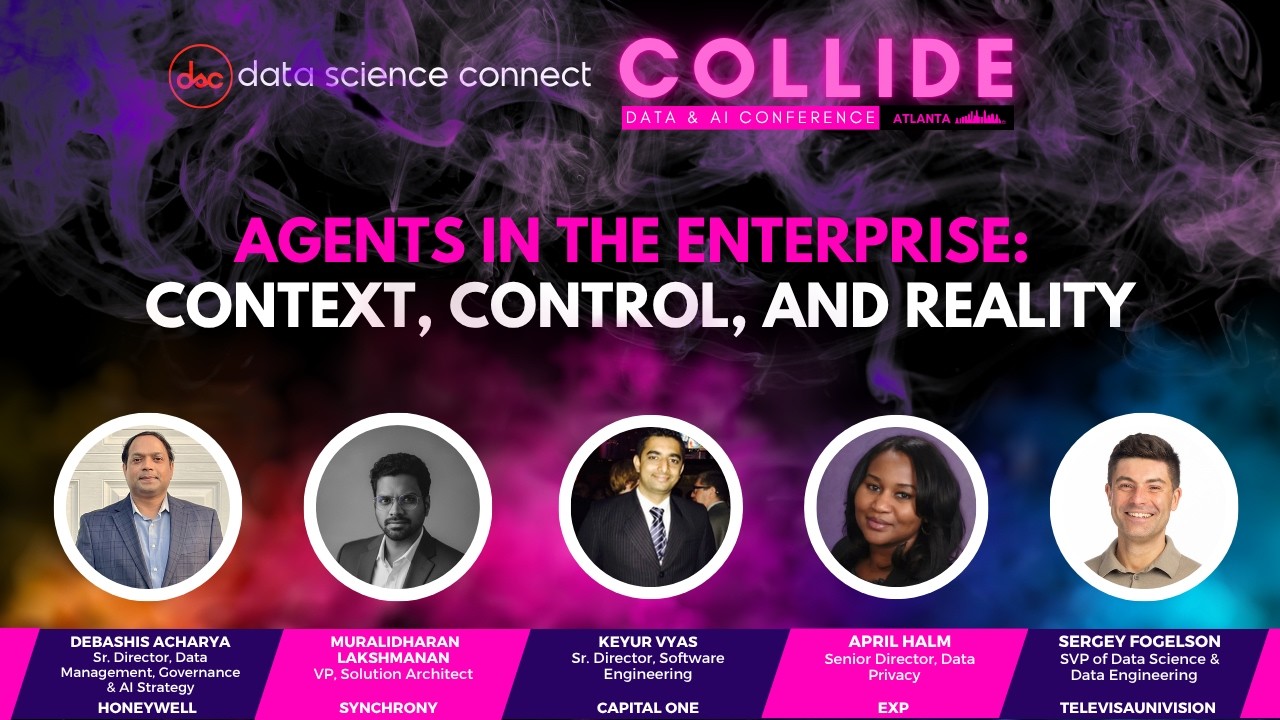
Enterprise GenAI faces a higher bar than consumer AI tools. In a Data Science Connect expert panel, leaders from AtScale, Nexla, Informatica, Vespa and Skyflow covered data minimization, semantic layers, single-number evaluation sets, architecture for scale and a lively debate over whether MCP will matter.
Key takeaways
- The enterprise quality bar is higher. Wrong numbers, invoices or refunds carry real cost, so accuracy has to move from roughly 75% toward 99% plus.
- Minimize and govern data first. Decide which data elements each tool may use, and apply row- and column-level security at query time.
- Context reduces hallucinations. Model intelligence and data relevance are the fundamentals; a semantic layer adds business context and confidence signals.
- Keep evaluation simple. Bratseth recommended one score on an evaluation set that reflects real outcomes, plus adoption tracking.
- Avoid model lock-in. Route work to different models by cost and sensitivity as newer and smaller models arrive.
Enterprise generative AI has a higher bar than the consumer tools employees use at home, and clearing it depends on security, data context and disciplined evaluation more than on the model itself. That was the consensus of a Data Science Connect expert panel webinar moderated by Brian Mink, co-founder and president of Data Science Connect, with David Mariani, CTO and founder of AtScale; Saket Saurabh, co-founder and CEO of Nexla; Bhimnath Mantha, technical architect at Informatica; Jon Bratseth, CEO and founder of Vespa; and Manish Ahluwalia, field CTO at Skyflow.
The session was brought to you by Nexla, Skyflow, Informatica, Galileo, AtScale and Vespa.ai.
Why is enterprise GenAI harder than consumer AI?
Enterprises hold far more valuable data than public tools can see, but that data comes with compliance, governance and regulatory obligations, Ahluwalia said. The winners, in his view, will be the companies that use their data and expertise in a secure and compliant way.
Mantha pointed to integration. GenAI apps are only powerful when they reach enterprise data, and some of that data sits behind legacy systems such as mainframes. Companies replacing mission-critical processes with GenAI also have to prove scalability and reliability before the business will trust them.
Accuracy was the common thread. In business intelligence, "if a number is wrong on a dashboard, somebody's in big trouble," Mariani said. He said AtScale has found that an LLM paired with a data platform alone gets the answer wrong 80% of the time, which is why the company pairs LLMs with a semantic layer. Saurabh framed the stakes in business terms: "Do we end up invoicing the wrong amount or refunding the wrong person?" The journey from roughly 75% accuracy to 99% plus, he said, is mostly traditional enterprise work in governance, monitoring and scalability.
How should enterprises secure sensitive data used with LLMs?
Ahluwalia started with data minimization. "You don't have the data, you don't have to worry about securing it," he said. Because proprietary data is an enterprise's advantage, the real question is which data elements should go to which tool for which purpose, and the answer differs for self-hosted and cloud tools.
Saurabh suggested building data products that carry documentation, meaning and access controls with them. An agentic system can then check which data products are relevant to a question, which ones the user is allowed to see, and what to pass to the model. Mariani added that a semantic understanding of data makes it possible to secure it semantically, with row- and column-level security applied at query time.
Mantha, who said he has built a number of agentic applications, stressed role-based access control and secure prompt design, including protection against prompt injection. "Prompts can make or break your application," he said.
How can companies reduce AI hallucinations and build trust?
Bratseth said teams should "focus 90% of the time on the fundamentals": the intelligence of the model and the relevance of the data delivered to it, which he described as old-fashioned information retrieval done for LLMs instead of humans.
Mariani said a semantic layer helps an application know when it could not find a declared metric and had to compute one, so it can tell the user it is less confident. Mantha said explainability helps developers as well as end users understand why a model behaved as it did. Saurabh added a people dimension: employees coming from consumer AI need training on the limits of outputs, such as not copying and pasting an AI answer to an investor's question without a check.
How do you monitor and evaluate GenAI apps in production?
Mariani said usage is the clearest signal: the number of users and the number of queries an agent satisfies. If an answer is wrong, people use a tool once and don't come back.
Mantha advised against a big-bang release. He would roll out new versions to a subset of users, compare them with the version the business already accepts, and add feedback analysis and anomaly detection on top of standard KPIs. Saurabh said LLMs can score both incoming questions and outgoing answers, offline and on a sample basis if needed.
Bratseth warned against dashboards full of metrics nobody can interpret. Teams should build an evaluation set that reflects real outcomes and track a single score on it. "It just should be one number," he said, noting that LLMs can now help build large evaluation sets cheaply.
What architecture decisions matter as AI scales?
Mariani said scaling starts with governance, because many companies have locked their data down for lack of confidence in their controls. Mantha recommended cloud-native elasticity, microservices and well-defined APIs. Bratseth said quality at scale requires keeping all data about an entity on the same node and running inference locally, across many shards in parallel.
Saurabh warned against coupling tightly to one model, since newer and smaller models keep arriving, and pointed to options such as OpenAI's batch API, which he said runs at half the cost if users can wait 24 hours. Ahluwalia described routing some sub-questions to a smart LLM and others to a cheaper model run on premises. On build versus buy, Mantha expects a hybrid of third-party foundation models and fine-tuning, while another panelist cautioned that fine-tuning usually shouldn't be the first step because out-of-the-box models are improving quickly.
The panel split on the Model Context Protocol. Mantha said MCP will give agents a common way to reach legacy systems, alongside Google's agent-to-agent protocol. Saurabh said orchestration across many MCP servers will need its own governance layer. Bratseth disagreed: "I don't think MCP will have much impact at all," he said, arguing that the harder problem is capturing the semantics behind APIs.
Continue the enterprise AI conversation in 2027
Expert panels like this one are part of Data Science Connect's free webinar program, which has 24 live sessions on the 2027 schedule across four series: the AI × Enterprise Panel Series, AI Demo Days, Agentic AI Showcases and the Plug & Play Series. Registration details for 2027 are coming soon.
Frequently asked questions
How do enterprises secure sensitive data used with LLMs?
Panelists recommended data minimization, data products with built-in access controls, role-based access, semantic row- and column-level security, and secure prompt design against prompt injection.
How do you reduce hallucinations in enterprise GenAI?
Bratseth said to focus on model intelligence and the relevance of the data delivered to the model; others added semantic layers, explainability and user training.
What KPIs should you track for a GenAI application?
Panelists suggested adoption by the target user group, queries satisfied, and a single score on an evaluation set tied to real-world outcomes.
Will MCP matter for enterprise AI?
The panel disagreed: Mantha sees MCP as a common layer to reach legacy systems, while Bratseth said it won't have much impact because it doesn't solve the semantics behind APIs.
Watch: Building Enterprise-Grade GenAI Applications: Balancing Innovation, Security, and Scalability on YouTube
Event: Webinars · More coverage: Webinars insights