At COLLIDE 2025, data and AI leaders from TK Elevator, Baptist Health South Florida and Novelis explained why agents raise the bar for data quality. They shared a five-step path from messy data to agent-ready data, governance for agents as digital employees, and a hub-and-spoke model for scaling.
Key takeaways
- Agents remove the human check. Agrawal said bad data that a model builder might catch goes straight into an agent's decisions.
- Training data must exist in production. Tungaraza warned that hand-assembled training sets may be missing once a model goes live.
- Treat agents as digital employees. Define what data and APIs each agent can touch, then monitor performance and value.
- Five steps from messy data: Jameel listed ownership, domain focus, medallion refinement, context and availability, and observability.
- Scale with hubs and spokes. Baptist Health's central AI team enables domain teams while data and governance stay centralized.
AI is only as good as the data behind it, and AI agents raise the stakes because no human checks their work before they act. That was the starting point for a panel at COLLIDE Data + AI Conference 2025 in Atlanta, in a session sponsored by Informatica, on what it takes to make enterprise data ready for agents.
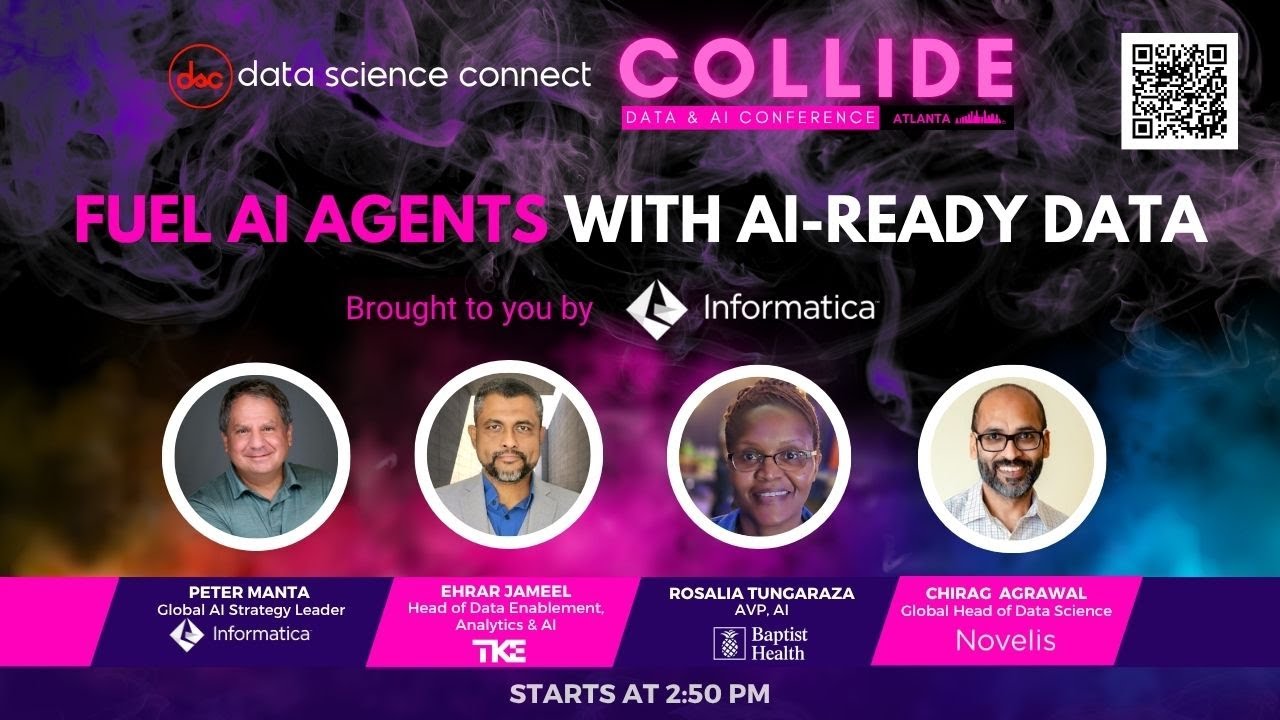
Peter Manta, Global AI Strategy Leader at Informatica, moderated the discussion with Ehrar Jameel, Head of Data Enablement, Analytics & AI at TK Elevator; Rosalia Tungaraza, AVP, AI at Baptist Health South Florida; and Chirag Agrawal, Global Head of Data Science at Novelis.
What makes data AI-ready?
Agrawal compared data to the ingredients in a kitchen. A chef needs to know what is on the shelves, where each ingredient came from and how it is labeled. Models need the same, he said, which means consistent definitions across the organization, so one system doesn't say "United States" while another says "USA." Governance and security, including masking or encrypting personal data, come next, or executives won't approve deployment.
Agents raise the bar further. With a person building the model, someone catches bad inputs. "Now if you give a bad data to your agent, it'll just freak out," Agrawal said. Agents also need discoverability: a clear description of what data exists, where it lives and what it means, ideally through a semantic layer.
Tungaraza added availability. Data used in training has to be available in production, she said. If a training set was assembled by hand from several locations, it may quietly be missing once the model goes live.
Manta summed up the panel's view as three pillars: data that is authoritative, comprehensive and handled responsibly.
How do you govern autonomous AI agents?
Tungaraza described agent governance as an extension of the AI governance Baptist Health already practices. A council reviews proposed AI work for alignment with business goals and sets policies everyone follows. Development leaves audit trails, and each agent's permissions are defined: what data and APIs it can touch and what security constraints apply.
"An agent is really a digital employee," she said, one that "can destroy things" and needs more guardrails than a person. Once agents are in production, teams monitor performance, data changes and hallucination, she said, and also keep checking whether the system still delivers the value it was built for.
Jameel said his team also sets cost thresholds for agents as part of a cost-benefit analysis. Manta cautioned that data governance and AI governance are "obviously very different things."
How do you get messy data ready for agents?
Jameel laid out five steps:
- Governance and ownership. Assign data owners, stewards and product owners, because without ownership no one knows who will fix messy data.
- Focus on business domains. Pick a specific business value, such as customer churn, rather than trying to "boil the complete ocean."
- Progressive refinement pipelines. Use a medallion architecture, moving raw data through bronze, standardized silver and gold layers, and build the gold layer only for the business case at hand.
- Availability and context. Make data discoverable through metadata and consumable through APIs, with a semantic layer or knowledge graph so that a term like a canceled contract means the same thing in sales and finance.
- Observability and AI governance. Build in feedback loops and monitoring.
Manta asked whether teams are skipping the medallion layers and putting AI directly on raw data. Jameel said that impulse comes from the push for speed, and his team is keeping the layered approach. Tungaraza agreed. "Curate your data, give your agent the data that it needs," she said, adding that her team has not tried putting an agent on raw data.
Agrawal said master data management is needed first, because people don't yet know everything their data contains. Over time, he expects agents to help break down data silos by retrieving data as needed.
How do enterprises scale AI agents beyond pilots?
Agrawal said the answer is selectivity. Novelis chose use cases tied to company strategy where data quality is less of a hurdle. One is plant safety, where cameras generate the data used to identify safety violations and decide how to change behavior. "It's produced by the camera," he said, so it is trustworthy data. Simulation for supply chain what-if analysis is another.
Tungaraza described a hub-and-spoke model at Baptist Health. A small central team that started out building AI is now enabling domain teams in areas such as supply chain, HR and marketing to build their own, experimenting quickly and expecting most ideas to fail. Out of 20 experiments, she said, perhaps two or three reach production with real value. Data stays centrally owned, each spoke gets curated access, and a data and AI governance council oversees the work, which she said keeps it from becoming shadow AI.
The panel's closing advice
- Jameel: Pick one high-value use case and prove it out end to end.
- Tungaraza: Involve business stakeholders from the start and make sure the solution addresses a major pain point. Don't build it in a silo.
- Agrawal: Don't try to fix all your data at once. Fix the data around one problem, solve it, and use that success to build momentum with executives.
Continue the conversation at COLLIDE 2027
COLLIDE, the largest AI conference in the Southern U.S., brings more than 1,000 enterprise data and AI leaders to Atlanta for keynotes and panels like this one. The 2027 conference takes place Wednesday, October 13, 2027, at the Sandy Springs Performing Arts Center. Details are at the COLLIDE event page, and Data Science Connect's free live webinars continue the discussion on data readiness throughout the year.
Frequently asked questions
What makes data ready for AI agents?
The panel pointed to trusted, consistently defined data that is discoverable through metadata or a semantic layer, available in production as well as training, and governed for security and privacy.
Should AI agents run on raw data instead of a medallion architecture?
Jameel and Tungaraza said they are keeping layered, curated data, arguing that agents perform better when given the data they need rather than raw tables.
How do you govern autonomous AI agents?
Tungaraza described a governance council, policies, audit trails, defined permissions for each agent, and ongoing monitoring of performance, data changes and business value.
How do enterprises scale AI agents beyond pilots?
Panelists advised picking one high-value use case tied to strategy, fixing only the data it needs, involving business stakeholders, and proving value end to end.
Watch: Fuel AI Agents with AI-Ready Data, brought to you by Informatica on YouTube
Event: COLLIDE AI Conference · More coverage: COLLIDE AI Conference insights