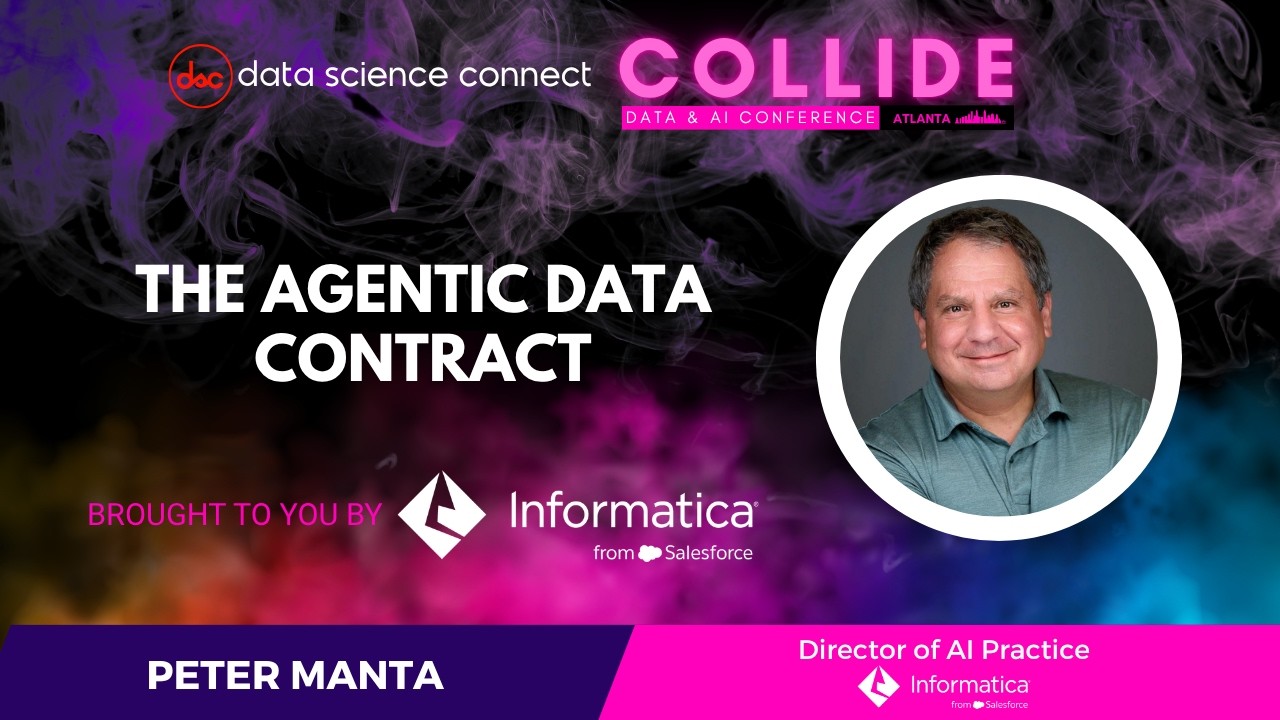
Data quality is an input, not the goal, Informatica's Peter Manta told COLLIDE 2026. What matters is whether AI agents make good decisions. He outlined six pillars of an agentic data contract and shared an experiment showing that even 10% duplicate data changed agent decisions.
Key takeaways
- Data quality is an input, not the goal. Manta said the target is decision quality, whether agents make good decisions on the data they get.
- Data cascades now move at machine speed. Small anomalies snowball through agentic systems and are often found late.
- Six pillars define the contract: data must be authoritative, comprehensive, contextual, timely, responsible and secure.
- Some mistakes can't be undone. Models can't easily unlearn data, so responsible and secure data is about prevention.
- No duplication level is safe. In Manta's experiment, any duplication caused about a 14% disagreement rate in agent decisions.
Enterprises often treat data quality as the cure for unreliable AI. Peter Manta, Director of AI Practice at Informatica, told attendees at COLLIDE Data + AI Conference 2026 in Atlanta that data quality is only an input. What matters for AI agents, he said, is decision quality.
In his session, "The Agentic Data Contract," Manta laid out six data requirements he has seen AI projects fail on, illustrated each with a well-known case, and shared results from his own experiments on duplicate data. He noted that Informatica is now part of Salesforce following an acquisition.
What is a data cascade?
Manta opened with a 2021 Google paper titled "Everyone wants to do the model work, not the data work." It describes data cascades: small anomalies that snowball as they move through an AI system. The paper found them often invisible, delayed and discovered far downstream, though often avoidable, he said.
With deterministic analytics models, cascades were fairly easy to catch and train out. In generative and agentic AI, he said, they create problems "at machine speed and a machine scale."
Why isn't data quality enough for AI agents?
When people say data quality will fix AI, Manta asks what they mean. A company can spend heavily on perfect global address data, but if no agent ever uses it, it does nothing for AI. "Data quality for the sake of data quality in the AI space is just kind of a vanity metric," he said.
Teams have three levers over an agent, according to Manta: the model, the prompt, and the data that shapes the agent's perception of reality. Agents don't experience the world. They aggregate the data they're given, so quietly wrong data leads to poor decisions and unchecked actions. "It's necessary here, but it's not sufficient," he said of data quality.
What is the agentic data contract?
Manta argued that a contract exists between agents and their data whether companies acknowledge it or not. He described six pillars, each with a cautionary example:
- Authoritative: the data tells the truth. Zillow Offers bought homes algorithmically until COVID-19 reshaped the housing market and the data no longer reflected the world, Manta said. The company lost hundreds of millions of dollars and laid off 25% of staff.
- Comprehensive: the whole truth, but not too much. Give an agent 19 of the 20 sources it needs and it has a blind spot; give it 100 and it gets confused. IBM Watson for Oncology skipped hard-to-access doctors' notes, he said, and did worse without the full picture.
- Contextual: the right truth for the situation. A New Zealand supermarket's leftover-recipe bot suggested dishes with bleach or ant killer when users typed them in. It understood a recipe's structure, not its purpose. "A recipe's meant to not kill the person that eats the food," Manta said. Business glossaries, semantic layers and knowledge graphs supply that context, as can unwritten practices like a nurse handing children a teddy bear on admission.
- Timely: true for current conditions. Google Flu Trends once spotted outbreaks about two weeks ahead of the CDC, Manta said, until autocomplete and changing news habits made searches reflect signal rather than illness.
- Responsible: prevention over cure. Models can't easily be untrained. "Once the AI learns something, there's no way to go back on it except re-training the model from scratch," he said. He cited Clearview AI, which he said was fined 30.5 million euros for scraping faces without consent.
- Secure: guard against unauthorized inference, not just access. In the Netflix Prize, researchers re-identified customers in a de-identified viewing dataset by matching it against IMDb, leading to lawsuits, according to Manta.
How does duplicate data affect AI agent decisions?
To quantify these risks, Manta ran experiments. In one, he generated 1,000 synthetic customers, added duplicate records at levels from 10% to 100% with realistic variations such as different phone formats, and asked an agent to classify each customer as high, medium or low priority.
At any level of duplication, even 10%, only about 86% of a customer's duplicate records received the same decision, and the rate stayed flat as duplication rose. "Any duplication results in this kind of 14% decision-making tax," Manta said. "There really is no safe duplication level."
He also had the agent report its confidence. The ideal zone for automation, high confidence on low-priority decisions, held just one customer. Consistent and inconsistent decisions were scattered across confidence levels, so no downstream threshold could separate them. The fix, Manta said, is an upstream deduplication gate: don't give agents duplicate data in the first place.
He said he is posting his experiments on GitHub so others can reproduce them.
Data for AI at COLLIDE 2027
COLLIDE, the largest AI conference in the Southern U.S., returns Wednesday, October 13, 2027, to the Sandy Springs Performing Arts Center in Atlanta, with more than 1,000 enterprise data and AI leaders expected. Learn more about COLLIDE, or join Data Science Connect's free 2027 webinars on enterprise data and AI.
Frequently asked questions
What is an agentic data contract?
Manta's framework for the implicit agreement between AI agents and their data. It requires data to be authoritative, comprehensive, contextual, timely, responsible and secure.
What is a data cascade?
A small data anomaly that snowballs as it moves through an AI system. A 2021 Google paper found cascades are often invisible and delayed, but often avoidable.
How does duplicate data affect AI agents?
In Manta's experiment with 1,000 synthetic customers, even 10% duplication meant only about 86% of a customer's duplicate records got the same decision.
Why isn't data quality enough for AI?
Quality scores alone can be a vanity metric. Manta said what matters is whether the data agents actually use leads to good decisions.
Watch: The Agentic Data Contract on YouTube
Event: COLLIDE AI Conference · More coverage: COLLIDE AI Conference insights