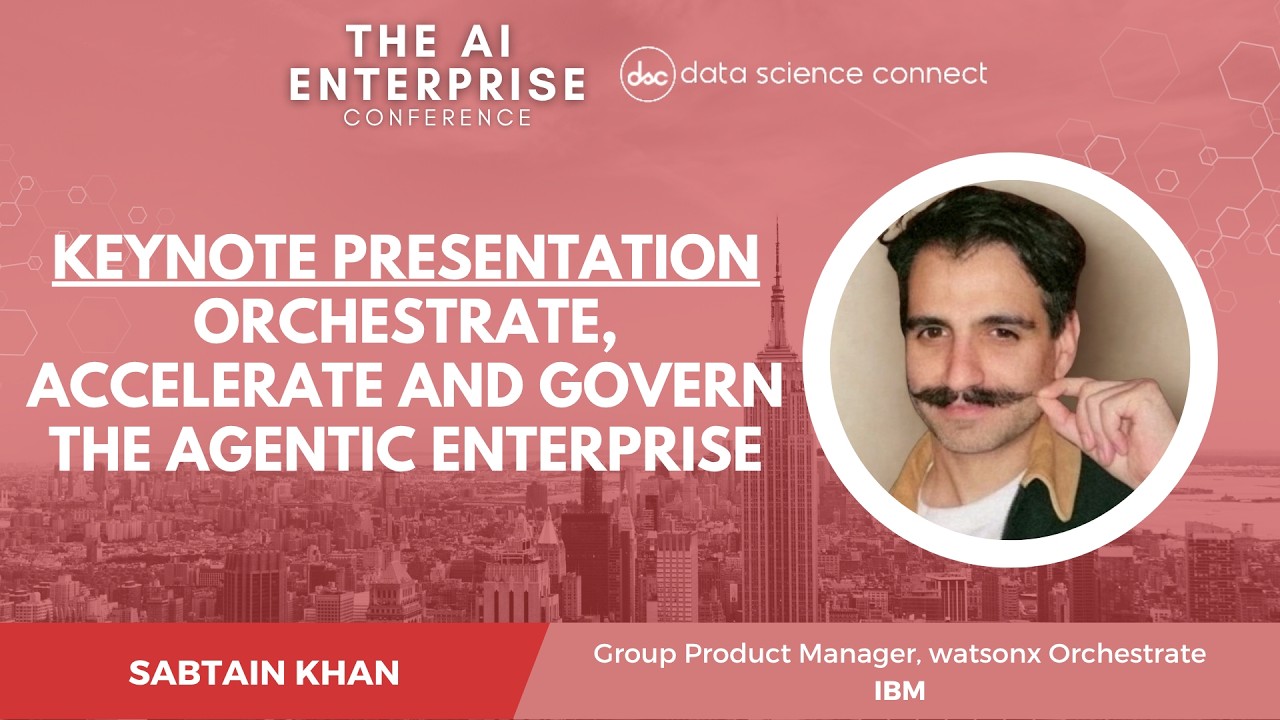
Anyone can build an AI agent now, IBM's Sabtain Khan said at The AI Enterprise Conference 2026, but few enterprises get agents deployed and used. He explained why agent sprawl is an operating model problem and how regular testing, feedback loops and a control plane help agents reach production.
Key takeaways
- Building agents is the easy part. Khan described a relative with no coding experience who built a CRM using about 30 agents.
- Agent sprawl is an operating model failure, with every team and vendor adding its own agents and portals.
- A control plane governs the whole estate, handling model fallback, load balancing, PII stripping and air-gapped deployments.
- Treat agents like software. Generate tests automatically, run them regularly and measure each change against the last evaluation.
- Let business users set policy. Developers handle evals and integrations; business users know the rules.
Building an AI agent has become easy. Getting one deployed, adopted and governed has not. In a keynote at The AI Enterprise Conference 2026 in New York City, Sabtain Khan of IBM, who said he has worked in AI product management at IBM, starting with Watson, for almost 10 years, explained why enterprises need to treat agents like any other production software, with testing, monitoring and a single place to control them.
"Building agents is the tip of the iceberg," Khan said.
How easy has it become to build AI agents?
Khan told the story of a relative in London who left a bank to start his own business. An enterprise CRM cost more than the business was making, so he used coding agents to build roughly 30 agents, each with a name, an employee number and a role, that together built him a working CRM with planning, UI design and QA.
When Khan asked to see his development environment, the relative said he had never opened one. "I've never written a line of code in my life," Khan recalled him saying.
If one person with no coding experience can do that, Khan asked, what are an enterprise's developers and product managers doing? He said he has about 10 agents running at home building an app. Because the barrier to building is so low, he estimated there could already be hundreds of millions of agents in use.
What is agent sprawl and why does it matter?
Inside large enterprises, every team uses its own tools, Khan said. Marketing, product and HR teams work in different systems with different schemas, and vendors such as ServiceNow, SAP and Workday each offer their own agents. The result is a sprawl of agents and fragmented experiences.
IBM clients have told him they want employees to use one portal, not 10, to finish a task. CIOs and admins want to know whether agents are working and what happens if an employee jailbreaks one, for example to grant a raise that shouldn't be given. Customer-facing agents carry higher stakes, he said, if a caller talks an agent into an unauthorized discount.
"It's not just a technology problem," Khan said. "It's an operating model failure."
What does an AI agent control plane do?
Khan compared the idea to a Kubernetes control plane: a single view of an enterprise's agent estate, wherever agents run and whatever models they use, with governance applied across all of them. IBM's product started as a simple agent builder, he said, but the team shifted its focus to governing agents once building them became too easy.
He described several functions a control plane should handle:
- Model fallback: if an agent's model fails, it switches to a backup
- Load balancing: spreading heavy request volumes across models running in different data centers, which many enterprises use to avoid depending on one provider
- Data protection: stripping PII before requests reach a model
- Support for air-gapped environments: for customers that run models entirely on premises
Connecting agents to back-end systems is where the real work starts, Khan said. Linking to a cloud drive may be simple, but a secure SQL database behind network tunnels and whitelisted IP addresses, or inside an air-gapped environment, adds a lot of complexity.
How should enterprises test and improve AI agents?
Chatting with an agent to test it doesn't scale, Khan said. Teams need tests generated automatically and run regularly, a way to see whether a change improved the agent compared with the last evaluation, and a way to turn user feedback into measurable fixes. Software teams already work this way with regression tests and QA before each release. "So, why isn't it like that for agents?" he asked.
When he asked the audience who had built an agent and then who had one in use by employees or customers, "I saw so many hands go up and then they kept going down," he said.
Khan demonstrated the approach with Bob, which he described as IBM's coding agent, working alongside Orchestrate, IBM's AI agent platform. In the demo, a customer service agent for a fictional phone company received negative feedback because it knew nothing about a product recall. Bob planned a fix with an inspectable task list, added a recall policy document to the agent's knowledge base for retrieval, and redeployed the agent, which then answered correctly. Khan said Bob connects to Orchestrate's agent development kit, so it already knows how agents are built, deployed and controlled.
Who should control AI agent policies?
Khan said controls such as PII stripping and model fallback should be available out of the box so they don't have to be coded each time. Developers should focus on evaluations, development and back-end integrations, he said, but "the business user knows the policies," so business users need a way to set them directly. A control plane should also bring in agents built elsewhere, including open-source LangGraph agents and agents from SAP, ServiceNow and Microsoft.
Hear more on agentic AI in 2027
Governing and scaling AI agents will again be a focus at The AI Enterprise Conference, which returns to Pier Sixty in New York City on Tuesday, August 31, 2027. Registration is coming soon on the conference page. Data Science Connect's Agentic AI Showcases, part of its 24 free 2027 webinars, also explore how enterprises build and run agents.
Frequently asked questions
What is an AI agent control plane?
As Khan described it, a single layer, similar in concept to a Kubernetes control plane, that shows all of an enterprise's agents and applies governance, fallback, load balancing and data protection wherever they run.
Why do so few AI agents reach production?
Khan said building agents is easy, but connecting them to secure back-end systems, testing them and governing them is where the real work begins.
How should enterprises test AI agents?
Generate tests automatically, run them regularly, compare each version against the last evaluation and turn user feedback into measurable improvements, as with regression testing in software.
What is agent sprawl?
The fragmented experience that results when different teams and vendors each deploy their own agents, often with different tools, schemas and portals.
Watch: Keynote Presentation: Orchestrate, Accelerate and Govern the Agentic Enterprise on YouTube
Event: The AI Enterprise Conference · More coverage: The AI Enterprise Conference insights