


In a Data Science Connect Agentic AI Showcase, Supermetrics, Striim and Lumi AI each gave a 10-minute live demo. They showed governed marketing data in Claude through MCP, real-time operational data streamed with PII masking, and an AI data analyst built on a curated knowledge base.
Key takeaways
- Supermetrics brings governed data to the LLM. Its MCP connector let Claude discover ad data sources and build a dashboard from a plain-language request.
- Striim targets data trapped in operational systems. Its demo streamed Oracle transactions to Snowflake via CDC, masking card numbers on the fly.
- Reading the MIT report closely. Bengtson said the 5% figure applied to task-specific projects, with about 40% of general-purpose LLM projects showing some return.
- Lumi AI depends on its knowledge base. Curated tables, column names, joins and business terms let its agents interpret vague requests.
- Each demo kept a check on output. Verified data, audit tables and human verification of AI insights.
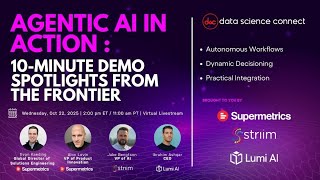
Three vendors showed how AI agents get the data they need, from marketing platforms, operational databases and enterprise data warehouses, in a Data Science Connect Agentic AI Showcase webinar hosted by Brian Mink, DSC co-founder and president. The session was sponsored by Supermetrics, Striim and Lumi AI, and each company had 10 minutes for a live demo.
The presenters were Evan Kaeding, Global Director of Solutions Engineering, and Alon Levin, VP of Product Innovation, both of Supermetrics; Jake Bengtson, VP of AI at Striim; and Ibrahim Ashqar, CEO of Lumi AI. A common thread ran through all three: agents are only as useful as the context and data quality behind them. Here's what each demonstrated.
Supermetrics: governed marketing data in Claude and ChatGPT through MCP
Kaeding opened with figures he said describe marketing's dilemma: 88% of teams are asked to do more with less budget, and only 13% of marketers properly use AI in their daily work. He added that, according to an MIT study, about half of enterprise AI projects relate to sales and marketing, so even non-marketing data teams are likely to see one.
Supermetrics' response has two parts, Kaeding said: agents inside its own platform for insights, dashboards, alerts, connector building and workflow orchestration, and an ecosystem approach that delivers governed data into tools customers already use.
Levin showed the second part. He connected the Supermetrics MCP server to the web version of Claude through its connectors settings, then asked in plain language for an overview of a brand's Facebook and Google ads activity over the past seven days. Claude discovered the available data sources, identified the two relevant ones, fetched the accounts and returned breakdowns, insights, a channel comparison and an instant dashboard. Supermetrics adds a semantic layer and guidance to help the LLM work with its data, Levin said, and the same connection works in ChatGPT.
The point, he said, is sanitized, verified data that keeps the LLM from inventing its own numbers. "You need to be able to trust your data," Levin said, especially in automated agentic workflows.
Striim: real-time operational data for AI agents
Bengtson explained that the two i's in Striim stand for "intelligent integration." The platform moves data from sources such as Oracle, SQL Server, Salesforce, Kafka and MQTT devices to cloud targets including Snowflake and Databricks, processing it along the way.
He also offered his reading of the MIT NANDA report on the state of AI in business. The widely shared figure that only 5% of GenAI projects produced a return applied to embedded or task-specific projects, he said, while about 40% of general-purpose LLM projects showed some return. "A 40% success rate is actually pretty amazing for a data science or an AI project," he said. One reason projects fall short, he said, is a lack of real-time context, since a lot of data that agents need is "trapped in operational databases."
His demo read credit card transactions from Oracle through change data capture and routed them to three Snowflake tables plus a Slack alert. An out-of-the-box masking agent detected sensitive data in real time and partially masked card numbers before they reached Snowflake, while writing audit metadata to a separate table. One flow flagged declined transactions; another used a continuous SQL query to join each transaction with card and merchant data and write a fact table on the fly. Bengtson loaded 10,000 transactions to show the pipeline running, and said agents could then read the fresh data through Snowflake's MCP server.
Lumi AI: an AI data analyst on a curated knowledge base
Ashqar argued that business intelligence is broken. Despite investments in warehouses and dashboards, he said, business teams still wait days for answers, and "having more dashboards doesn't mean having more insights." The insights that matter often need SQL or Python skills held by a few swamped analysts.
Lumi's answer is an agentic layer that acts as an AI data analyst. Its platform has four modules: chat, boards, a knowledge base and verifications, which let users ask a human analyst to check any AI-generated insight.
In the demo, a supply planner asked which items in "PBNA" had the largest drop in sales between two periods. Lumi knew from its knowledge base that the term meant a specific product category, generated SQL dynamically, charted the results and suggested follow-ups. A follow-up found that the top item had 18 days out of stock in November 2023. A second, multi-step question asked which high-demand raw materials had the lowest weeks of supply, then added recommended replenishment quantities to the same report.
Users can open a "show thinking" view to see the agents rephrase the prompt, pull context and memories, and explain the query's assumptions in plain language. "Without the knowledge base, the agents would not be able to produce any meaningful output," Ashqar said. Teams curate it by choosing tables and fields, renaming vague columns, defining joins, adding business terms and KPIs, reviewing thumbs-up and thumbs-down memories and setting viewer or contributor permissions.
What the three demos had in common
Each vendor focused less on the agent than on what feeds it: governed marketing data through MCP, masked real-time operational data, and a curated semantic knowledge base. Each also kept a way to check the output, from verified data sources to audit tables to human verification.
Watch the next Agentic AI Showcase
Agentic AI Showcases are one of four series on Data Science Connect's 2027 calendar of 24 free live webinars, alongside the AI × Enterprise Panel Series, AI Demo Days and the Plug & Play Series. See the webinar schedule for upcoming sessions.
Frequently asked questions
How do AI agents access marketing data?
In the Supermetrics demo, an MCP connector linked Claude to governed marketing data sources, letting it find relevant ad accounts and return insights and dashboards from a plain-language request.
Why do AI agents need real-time data?
Bengtson said much of the data agents need is trapped in operational databases, while warehouses are often built for periodic reporting, so change data capture can stream fresh data to zones agents read through MCP.
What is an AI data analyst?
Ashqar described it as an agentic layer connected to source systems or a warehouse that understands business terminology and data quirks, so users can ask questions in plain language.
How do you give AI agents business context?
Lumi's demo showed a knowledge base where teams select tables and fields, rename vague columns, define joins, add business terms and KPIs, and curate feedback memories.
Watch: Agentic AI in Action: 10-Minute Demo Spotlights from the Frontier on YouTube
Event: Webinars · More coverage: Webinars insights