





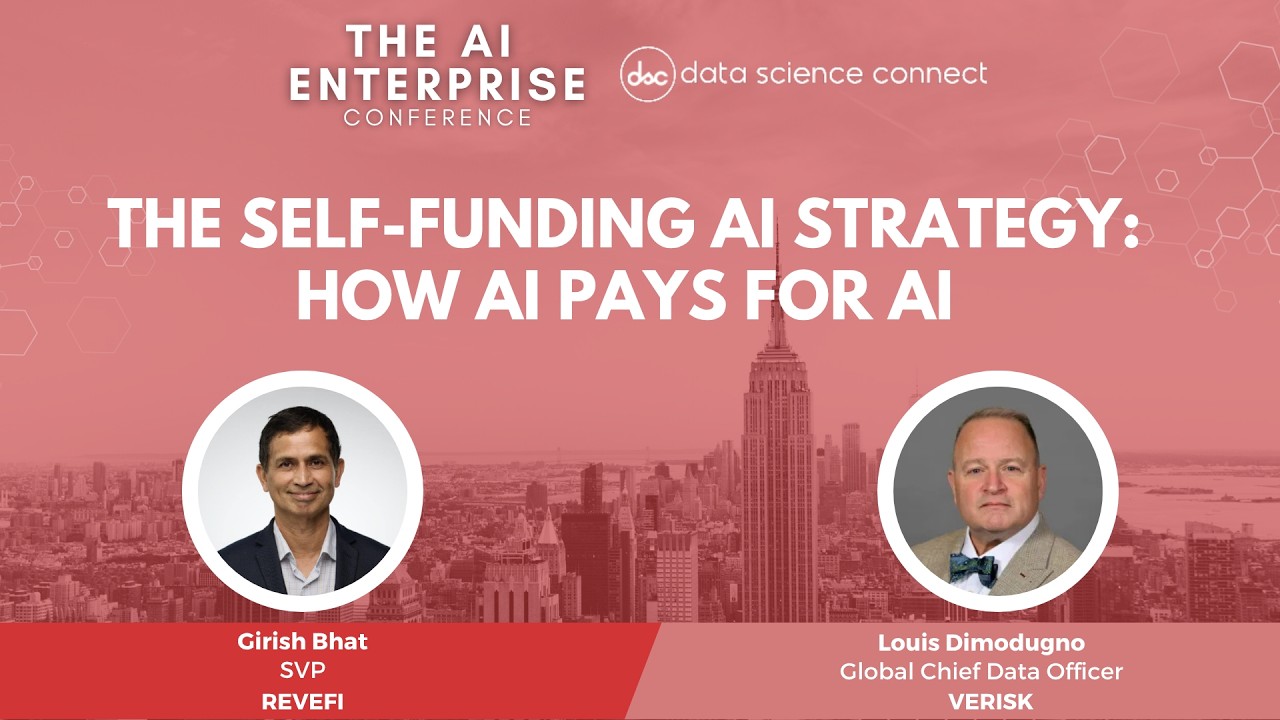
At The AI Enterprise Conference 2026, Revefi's Girish Bhat argued that the best-funded AI programs will pay for themselves by reclaiming wasted data and AI spend. Verisk Global Chief Data Officer Louis Dimodugno described how Snowflake savings covered the cost of the tooling, and why token prices may soon rise.
Key takeaways
- Waste can fund AI. Bhat said the best-funded AI programs in 2027 will be primarily self-funded from reclaimed data and AI spend.
- The tooling paid for itself. Dimodugno said Snowflake efficiencies at Verisk covered the cost of Revefi right away.
- AI costs can spike fast. One engineer's coding agent ran up a $76,000 bill in under two days, Bhat said.
- Visibility comes first. Spend broken down by model, business unit and individual makes AI costs manageable.
- Protect the savings. Ring-fence reclaimed budget before other teams claim it.
Most AI leaders are asking for bigger budgets. Girish Bhat of Revefi argued for a different approach: reclaim the money already being wasted on data platforms and AI, and use it to pay for the next round of AI work. Bhat made the case in "The Self-Funding AI Strategy: How AI Pays for AI" at The AI Enterprise Conference 2026 in New York City, joined by Louis Dimodugno, Global Chief Data Officer at Verisk, who shared how the approach played out at his company.
Bhat said he believes the best-funded AI programs in 2027 will be "primarily self-funded," a view he acknowledged sounds contrarian when vendors and analysts are urging companies to invest more.
What is a self-funding AI strategy?
The idea is to find and cut waste in data and AI spending, then redirect the savings into new initiatives, Bhat said. He traced the problem to the move from on-premises systems to consumption-based cloud pricing, which he said produced blown budgets alongside data quality and performance issues that the cloud masked rather than solved. He said he saw the same dynamic during his years at Splunk.
Revefi, which Bhat described as a four-and-a-half-year-old AI and data startup based in Redmond, Washington, started by targeting data platform spend, quality and performance. It has since expanded to AI workloads, where Bhat said the cost problem is 10 to 100 times more urgent.
How did Verisk use savings to fund AI?
Verisk has been around for about 45 years and has collected data from nearly every insurance carrier, Dimodugno said. It now holds almost 60 petabytes of insurance data, which it uses for carriers' regulatory filings, industry benchmarking, anti-fraud work and catastrophe modeling.
Verisk had been a Snowflake user for years, Dimodugno said, but its balance of processing and storage capacity wasn't being maintained efficiently. Revefi deployed more than 665,000 monitors across its systems, and the efficiencies it found in the Snowflake deployment paid for the Revefi investment right away, he said. Further savings have followed.
Dimodugno, who said this is his third role as a chief data officer, said he tries to "migrate away from governance and focus on observability," making data transparent so others across the organization can use it. Because Verisk receives data from the same carriers repeatedly, monitoring over time also helps it spot quality issues as they arrive.
Why are AI costs so hard to control?
Many organizations have bought tokens and given engineers access without a clear way to see who is consuming what, or how fast, Dimodugno said. Transparency into AI spending, down to division and individual level, is what lets Verisk report to its executive team on where tokens go.
Bhat shared two anonymized examples. At one of the world's largest investment firms, he said, a single engineer using a coding agent in Snowflake's Cortex Code ran up a $76,000 bill in under two days. Revefi's product intercepted it. At another large company spending more than $100 million on AI, he said, Revefi has already saved seven figures. He said customers typically see 30% to 40% savings on LLM spend, though he added that a company spending $500 a month shouldn't bother.
How can companies manage AI spend with policy?
In a demo, Bhat showed Revefi's AI FinOps and observability product, which breaks down spend by input and output tokens, model type, business unit and cost center to support showback and chargeback. He described policy-driven limits enforced through the company's own gateway, MCP servers and model routing, such as an unlimited quota for a global chief data officer and $10,000 a month for a vice president. The product also offers prompt tracing and what-if analysis on model choice and latency.
What is the self-funding AI playbook?
Bhat closed with a four-step playbook:
- Baseline your waste across data and AI. He cited one customer that reclaimed $1 million in spend.
- Instrument from day one using standard protocols.
- Prove and optimize, using what-if analysis before production.
- Ring-fence the savings. Once savings are reclaimed, "protect it like it's your own money," Bhat said, because other teams will try to claim them.
Dimodugno ended with a warning. Token prices are changing almost daily as frontier model providers compete for market share, he said, and once those companies go public, prices are likely to rise. Organizations without visibility into how AI is consumed will be caught off guard. "The financial piece is the piece that's always going to get the most attention," he said.
More on AI economics at The AI Enterprise Conference 2027
How to prove AI value and control its cost was one of the most discussed questions at the 2026 conference. The AI Enterprise Conference returns to Pier Sixty in New York City on Tuesday, August 31, 2027, with registration coming soon. Data Science Connect's free webinars, including the AI × Enterprise Panel Series, continue the conversation online.
Frequently asked questions
What is a self-funding AI strategy?
As Bhat described it, reclaiming wasted spending on data platforms and AI and redirecting those savings to fund new AI initiatives.
How much can companies save on LLM spending?
Bhat said Revefi customers typically see 30% to 40% savings on LLM spend, though he said very small spenders needn't bother.
Why might AI token prices rise?
Dimodugno said frontier model providers are cutting prices to win market share, and he expects token charges to go up once those companies go public.
How do you control AI spending across teams?
Track spend by model, business unit, cost center and individual, and set policy-driven quotas enforced through a gateway, Bhat said.
Watch: The Self-Funding AI Strategy: How AI Pays for AI on YouTube
Event: The AI Enterprise Conference · More coverage: The AI Enterprise Conference insights

