Most companies still equate generative AI with chatbots. At COLLIDE 2024, leaders from Dollar General, Scripps, TelevisaUnivision, Vertex and PRGX described content tagging, dynamic dashboards, code translation and survey analysis, and were candid about security risks, unreliable outputs and measuring ROI.
Key takeaways
- Chatbots are only the start. Panelists described dynamic dashboards, legacy code translation, content tagging, ad-break detection and automated clipping.
- Security and validation are the main blockers. Fogelson said outputs can turn to random strings without warning, so humans still validate them.
- Start small and internal. Focused internal use cases with clear value build buy-in before larger investments.
- Set expectations early. Dingare tells users to treat generative AI as an unreliable intern that works about 80% of the time.
- Measure against a baseline. Scripps compared analysts with LLMs on open-ended survey analysis and saved about 30 hours.
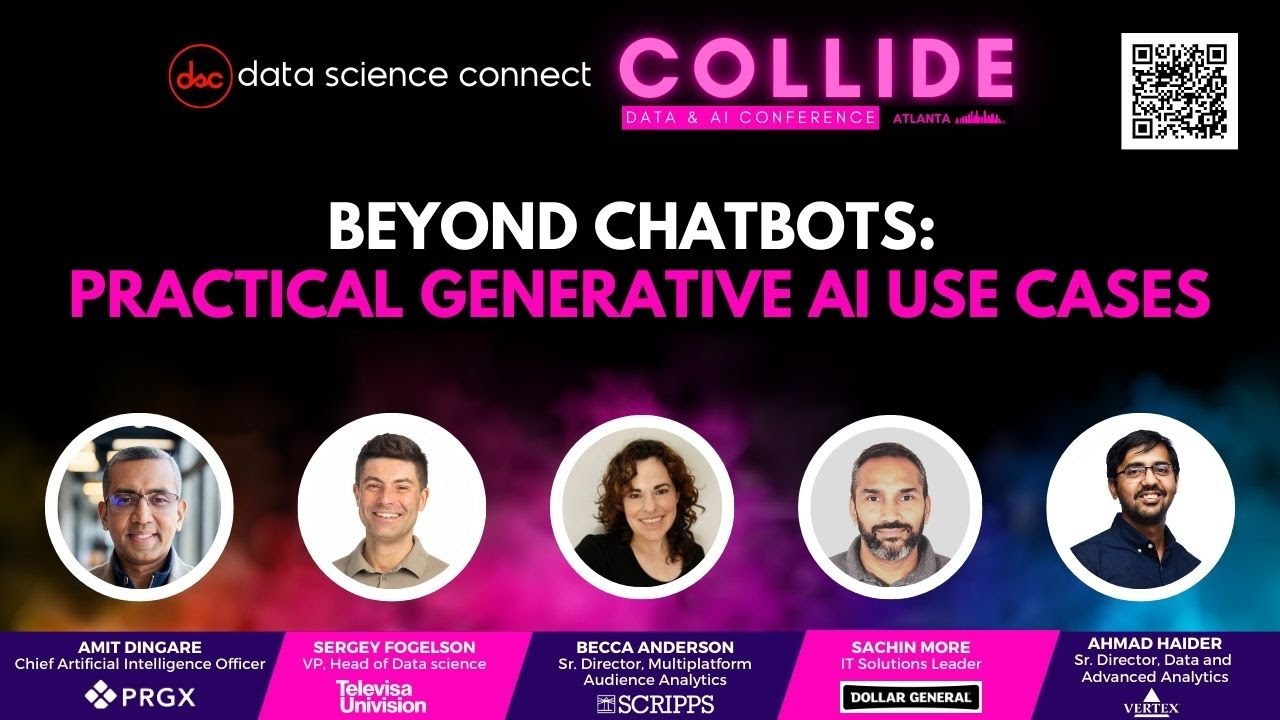
When people describe their generative AI work, the most common answer is still "we are building a chatbot," according to Amit Dingare, Chief Artificial Intelligence Officer at PRGX Global. That, he said, leaves most of the technology's potential unused. At COLLIDE Data & AI Conference 2024 in Atlanta, Dingare moderated a panel on practical generative AI use cases with Sachin More, IT Solutions Leader at Dollar General; Becca Anderson, Senior Director, Multiplatform Audience Analytics at The E.W. Scripps Company; Sergey Fogelson, VP and Head of Data Science at TelevisaUnivision; and Ahmad Haider, Senior Director, Data and Advanced Analytics at Vertex.
The panel spanned retail, broadcast and streaming media, biotech and procurement, and the speakers were candid about where generative AI still falls short.
What are practical generative AI use cases beyond chatbots?
More named two. The first is turning static KPI dashboards, such as a fixed list of a store's top 100 sellers, into dynamic ones where users can ask about the bottom 100 items or top categories. The second is converting legacy code, such as AS/400 mainframe applications, into modern languages.
For media companies, metadata is the big opportunity. Anderson pointed to content discoverability and personalized app and web templates for streaming products. Fogelson described automatically tagging a content library with actors, moods and keywords to support ad sales, talent evaluation and decisions about what gets made. TelevisaUnivision is also using generative AI to find ad breaks in long-form programs such as an hour-long novela and to identify clippable content.
Haider pointed to personalized medicine, drug discovery and design work, such as the coatings and layers he worked on in semiconductors. Dingare added information retrieval and summarization across large collections of text and images.
Fogelson pushed back on code generation. He said he has had significant trouble with coding assistants and sees more promise in translating code from one language to another. He doesn't expect a fully competent AI developer within five years.
What are the biggest challenges of implementing generative AI?
Security came up first. More said the strongest pushback he faced came from IT security, because data is intellectual property. Fogelson described an LLM "unleashed within your environment" as "basically like a completely untethered open client" connected to both the internet and internal data.
The second problem is verifying outputs. In TelevisaUnivision's tagging work, Fogelson said, the same title can return good labels twice and random strings of characters the third time. Validating every output takes "an army of humans or several highly caffeinated humans," he said.
Anderson said fear is a barrier at Scripps, a traditional broadcaster. Even with executive support, proofs of concept struggle to win buy-in from peers and staff, and legacy infrastructure makes scaling them hard. Dingare added that much knowledge is still tribal and not yet digitized, and that unreliable outputs make it harder to earn business stakeholders' trust.
How should organizations integrate generative AI into workflows?
The panel agreed on starting small. Haider recommended picking focused use cases with clear business value, then forming a cross-functional group, which some companies call a center of excellence. Decisions about privacy boards, compute and technology should follow that early learning, he said.
Fogelson and Anderson both recommended internal use cases first, such as metadata tagging and automated clipping. At Scripps, Anderson's team is also working to surface failure points in video delivery quickly so it can identify affected audiences and revenue. More suggested plugging generative AI models into data warehouses that already power dashboards.
Dingare said setting expectations is just as important. He tells business users to treat the technology as "an unreliable intern that's going to work quite well for about 80% of times," with the human as the final decision maker.
How do you measure the ROI of generative AI?
Fogelson said every deployment is an experiment that needs measurable outcomes, such as hours saved on a process that actually matters. Sometimes a rules engine or classic machine learning would do the job, he said.
Haider offered three categories of metrics. Wall Street metrics cover revenue, costs and customers. Company metrics cover internal efficiency. Industry metrics measure competitive differentiation.
Anderson gave a concrete example. Her team had analysts code open-ended survey responses and app reviews by hand, then ran LLMs on the same task. The comparison showed about 30 hours saved, though people still check that the themes reflect the text. Dingare said the hardest part is often getting a baseline, because few companies track time by individual task.
Where do ethics limits apply?
Anderson said Scripps won't use generative AI to create news content or video, because it doesn't want to introduce bias or create echo chambers. Even AI-generated headlines remain experimental and require an editor. More said ethics starts with data privacy and respecting others' intellectual property.
In a lightning round, panelists named content creation, summarization and enrichment, design, and AI agents and multimodal models as the most promising next steps.
Hear more practitioner panels at COLLIDE 2027
COLLIDE, the largest AI conference in the Southern U.S., brings more than 1,000 enterprise data and AI leaders to Atlanta. The 2027 conference takes place Wednesday, October 13, 2027, at the Sandy Springs Performing Arts Center, with registration coming soon. Data Science Connect also runs free live webinars on enterprise AI throughout the year.
Frequently asked questions
What are generative AI use cases beyond chatbots?
Panelists cited dynamic KPI dashboards, legacy code translation, automatic content tagging, finding ad breaks, clipping video, summarizing survey responses, and design and drug discovery.
Why is generative AI hard to put into production?
Security risks from LLMs connected to internal data and the internet, plus outputs that are unpredictable and hard to validate, Fogelson said.
How do you measure generative AI ROI?
Define measurable outcomes and a baseline. Haider suggested tracking financial results, internal efficiency and competitive differentiation.
Should media companies use generative AI to create news?
Anderson said Scripps won't use it to create news content or video and keeps an editor involved even in experimental AI headlines.
Watch: Beyond Chatbots: Practical Generative AI Use Cases on YouTube
Event: COLLIDE AI Conference · More coverage: COLLIDE AI Conference insights