





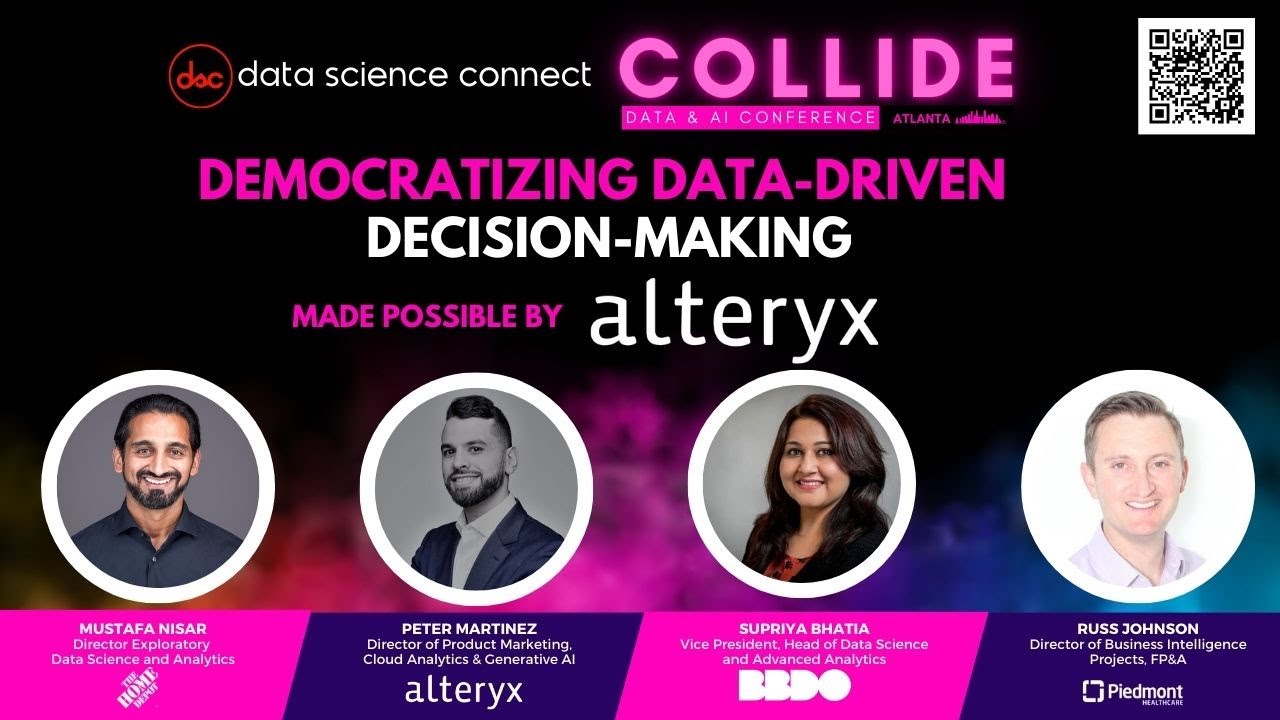
How do you open data to non-technical employees without exposing sensitive information? At COLLIDE 2024, leaders from Piedmont, The Home Depot, Alteryx and BBDO described certified data sets, business-owned data hubs, time-limited PII access and a break-the-glass log for health data.
Key takeaways
- Fit the method to the organization. Johnson said companies can invest in user-friendly tools or in people; Piedmont chose people and certified data sets.
- Democratization is not all or nothing. Nisar said each use case needs a different level of data granularity and sensitivity.
- Nail the basics first. Martinez said most organizations he assessed scored around 2.2 on a five-point maturity scale.
- Let the business own access. At Piedmont, business data owners approve time-limited PII access through an automated tool.
- Log every look at health data. Piedmont's break-the-glass tool requires a stated purpose each time protected health information is viewed.
"Data is often called the new oil, but unlike oil, it shouldn't be a scarce resource limited to a few," said Supriya Bhatia, Vice President and Head of Data Science and Advanced Analytics at BBDO, as she opened a panel on democratizing data-driven decision-making at COLLIDE Data & AI Conference 2024 in Atlanta.
Bhatia moderated a discussion with Peter Martinez, Director of Product Marketing, Cloud Analytics & Generative AI at Alteryx; Mustafa Nisar, Director of Exploratory Data Science and Analytics at The Home Depot; and Russ Johnson, Director of Business Intelligence Projects, FP&A at Piedmont. The panel covered how to give non-technical employees access to data without losing control of sensitive information.
How do you make data-driven decisions accessible to non-technical employees?
There is no single best method, Johnson said. Organizations can invest in user-friendly tools or in people, and the choice should fit the organization's structure. Piedmont chose people. Its team builds its own tools to prepare data, publishes certified data sets on Tableau Server, and lets end users build their own data sources and visualizations in Tableau Desktop.
Martinez, who spent five years in Gartner's consulting practice before joining Alteryx, said organizations need a holistic approach across four factors: process, governance, tooling and people. Each sits on a continuum, he said. Some use cases call for a clean, curated data set, while others call for a finished dashboard or deck.
At The Home Depot, Nisar said, product and user experience teams want to use LLMs to find customer friction points in unstructured data such as feedback. The approach is to allow lighter guardrails while teams build hypotheses, then require a validated set of data once the organization commits to a strategy.
What are the biggest barriers to data democratization?
Nisar named access first. Silos lead to incomplete decisions, such as store pickup data that isn't connected to customers' digital experience data. Bringing data into a cloud environment with the right access controls can remove the silos without heavy integration work. The second barrier is governance, which he said "shouldn't be an ad hoc decision." It should be based on data sensitivity and the minimum exposure needed to make a decision.
Johnson added processing power and headcount. More users mean more queries and more questions, so organizations have to choose which constraints to fight. Broad data governance policies let them expand access without massively scaling infrastructure, he said.
Why nailing the basics creates the most value
On a one-to-five maturity scale, the organizations Martinez assessed as a consultant typically scored around 2.2, even those with advanced analytics functions. "There's tremendous value that's yet to be unlocked in just nailing the basics," he said, such as getting departments to agree on a basic count.
Johnson said the biggest benefit of democratization is "getting data into the hands of the people who have the most context for that data," the business owners. Piedmont is rolling out a product management model it calls data hubs. Business partners act as brand owners of the data products the data team builds and decide what gets prioritized next.
That requires curious analysts. Johnson said the generic request is always the same: "I need a report." His team is expected to ask what problem the requester is actually trying to solve and work backward from there.
Martinez suggested letting data engineers do the first curation, including removing PII, then giving business users room for the roughly 10% of ad hoc data manipulation and investigation they can handle themselves.
How do you balance data access with security and governance?
When it comes to data democratization, "it's not all or nothing," Nisar said. Reporting, prescriptive insight, model features and system integration each require different levels of granularity. He said teams often don't need to expose PII to build a model, because identities can be translated in ways that keep data anonymized.
Johnson described Piedmont's approach in detail. Every data set starts locked down, and every PII field is granted only by exception. Users request access through a web-based tool that routes to the business data owner, not the data team. The owner can approve access permanently or for a limited period, such as 30 days or one day, and scripts grant and revoke it automatically.
A second tool, called "break the glass," applies to protected health information. Even users with access must log a business or clinical purpose each time they view it. Audit reports are built automatically, so Piedmont can show external auditors who accessed any field, why and who approved it.
What role should leaders play?
Nisar said leaders should define objectives, align teams on common metrics and stay open to experimentation. Johnson said business leaders must drive change management, because people's willingness to change, more than model accuracy, often limits adoption. "You can have the greatest, most effective model in the world," he said, but it won't succeed if the organization won't integrate it into daily work. Martinez said leaders should consistently ask for data when their teams bring them recommendations.
Join the conversation at COLLIDE 2027
COLLIDE, the largest AI conference in the Southern U.S., brings more than 1,000 enterprise data and AI leaders to Atlanta. The 2027 conference takes place Wednesday, October 13, 2027, at the Sandy Springs Performing Arts Center, with registration coming soon. Data Science Connect also hosts free live webinars on data and AI strategy.
Frequently asked questions
What is data democratization?
Making data and insights accessible, understandable and actionable for employees regardless of role or technical expertise, as the panel's moderator framed it.
What are the biggest barriers to data democratization?
Panelists named data silos and access, governance, processing power and the headcount needed to support more users.
How do you control PII access in self-service analytics?
Piedmont locks down every PII field by default, routes access requests to the business data owner, grants access for set periods automatically and keeps audit reports.
What is a break-the-glass control?
At Piedmont, a tool that requires users to log a business or clinical reason every time they access protected health information, even if they already have access.
Watch: Democratizing Data-Driven Decision-Making on YouTube
Event: COLLIDE AI Conference · More coverage: COLLIDE AI Conference insights


