





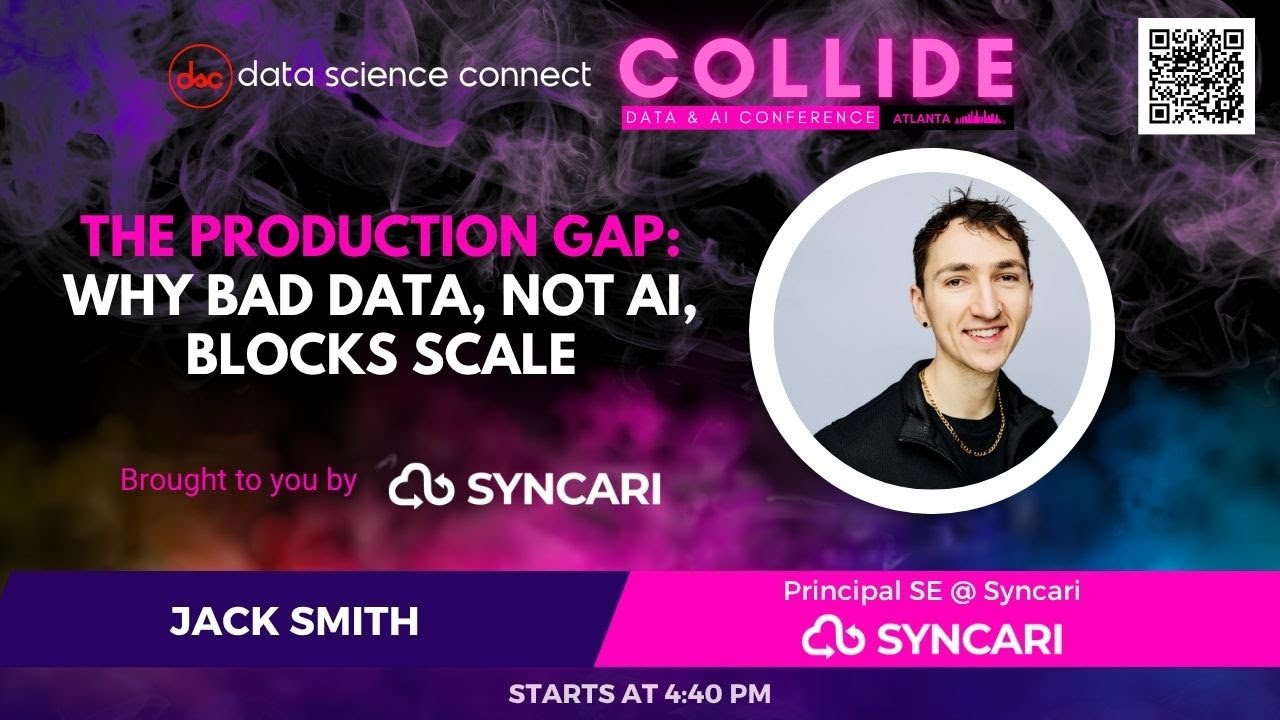
AI pilots often fail in production because they run on siloed slices of untrusted data. At COLLIDE 2025, Syncari Principal Solutions Engineer Jack Smith argued that more integration tools and data lakes won't fix that, and laid out the case for a centralized, agentic master data layer.
Key takeaways
- Integration sprawl is a symptom. Smith cited an analyst average of 14 integration tools per enterprise.
- Pilots run on slices. AI attached to individual apps or warehouses works from siloed data that doesn't scale in production.
- Legacy MDM is too slow. Smith said traditional projects can take three or four years and are hard to change once deployed.
- Centralize governance. A single agentic data layer lets agents, assistants and apps work from the same governed data.
- Face technical debt early. Hidden debt surfaces when AI hits production data, Smith warned.
AI pilots stall in production because of fragmented, untrusted data, not because of the models, Syncari Principal Solutions Engineer Jack Smith told attendees at COLLIDE Data + AI Conference 2025 in Atlanta, in a session sponsored by Syncari. Smith argued that adding more integration tools, data lakes or traditional master data management (MDM) projects won't close what he called the production gap, and he made the case for a centralized, agentic data layer instead.
Why do AI pilots fail when they reach production?
Smith opened by polling the room on how many integration tools each company runs. It is common to have 10, 15 or 20, he said, and he cited analyst figures putting the enterprise average at 14. "If integration worked, you wouldn't need 14 different tools," he said.
Most AI pilots work on a small subset of data, Smith said, and neither the data nor the process scales once the pilot hits production. A typical stack moves data from SaaS applications, warehouses, chat logs and documents into one warehouse, transforms it into another, and feeds analytics. What that structure doesn't cover, according to Smith, is governance, observability, automation, freshness and unstructured data.
When teams bolt AI pilots onto individual applications, such as a website chatbot or document OCR, each one still works from a siloed slice of data. "Integration is not a strategy, neither is siloed warehouses," Smith said.
Why aren't data lakes or traditional MDM enough?
Consolidating into data lakes still leaves silos, Smith said. Organizations end up with shadow data lakes alongside official lakes and warehouses, each run by a different team with its own AI on top. Companies are also still trying to stop employees from pasting proprietary data into public chatbots, he added.
Traditional MDM has its own problems, in Smith's view. Projects can take three or four years, by which time the original requirements have changed, and he said many companies that started MDM projects before the AI boom are still working on them. Even once deployed, he said, these systems are slow to change and slow to deliver value to business teams.
What is agentic MDM?
Smith described agentic MDM as a central data layer that runs more autonomously, healing and iterating over time, and that feeds governed data to AI models, agents and applications. He said teams can build this themselves or buy it.
In the architecture he outlined, data from SaaS applications, databases, warehouses and lakes flows into a core layer where technical and non-technical teams can govern and manage it together. That unified data hub supports natural language queries and standard BI, streams updates back to source applications, and sits behind a centralized MCP server for agents and apps.
The case for centralizing is governance, Smith said. AI tools that connect to each system separately have no central control. "You'll have the same authentication for a CIO as you would a data steward," he said. A central layer acts as a wrapper so that assistants, agents and apps all work from the same governed data.
Smith said Syncari implemented this approach with Altair, a Siemens company, a little over a year and a half before the talk, centralizing governance, workflow and data modeling and then feeding master data, lifecycle management and finance use cases from that layer.
What breaks AI projects at scale?
Smith listed the recurring obstacles:
- Technical debt, often 20 years of systems that only some people understand, plus data that not everyone trusts
- Integration failures, as APIs, systems and processes change and become harder to track
- Lack of real-time observability, including stale data and pipeline bottlenecks that delay outputs to business users
- Governance gaps, making sure the right people access the right data at the right time without leaks
He said he had spoken with chief data officers, CIOs and other technical leaders at at least three conferences that year, and they consistently named governance, trust, technical debt and scaling as the issues that break AI efforts.
How can companies close the AI production gap?
Smith closed with three recommendations. First, confront technical debt. "Don't shovel it under the rug," he said, warning that debt hidden in the name of something new will surface when the work hits production data.
Second, figure out what will make the people consuming the data trust it, since adoption depends on that trust. Third, don't let small AI pieces run independently. Plan for scale as data sets grow and more people adopt the models, he said.
Explore AI-ready data at COLLIDE 2027
COLLIDE, the largest AI conference in the Southern U.S., brings more than 1,000 enterprise data and AI leaders to Atlanta for sessions on data foundations, governance and scaling AI. The 2027 conference takes place Wednesday, October 13, 2027, at the Sandy Springs Performing Arts Center. More information is at COLLIDE, and Data Science Connect's free live webinars continue the conversation between events.
Frequently asked questions
Why do most AI pilots fail to scale?
According to Smith, pilots work on small, siloed subsets of data, and neither the data nor the process scales once they reach production.
What is agentic MDM?
Smith described it as a central master data layer that runs more autonomously, healing and iterating over time, and feeds governed data to AI models, agents and applications.
Are data lakes a foundation for enterprise AI?
Smith argued they are not on their own, because companies end up with shadow lakes and separate warehouses run by different teams, each with its own AI.
What blocks AI projects at scale?
Smith named technical debt, integration failures, lack of real-time observability and governance gaps as the recurring obstacles.
Watch: The Production Gap: Why Bad Data, Not AI, Blocks Scale, brought to you by Syncari on YouTube
Event: COLLIDE AI Conference · More coverage: COLLIDE AI Conference insights


