





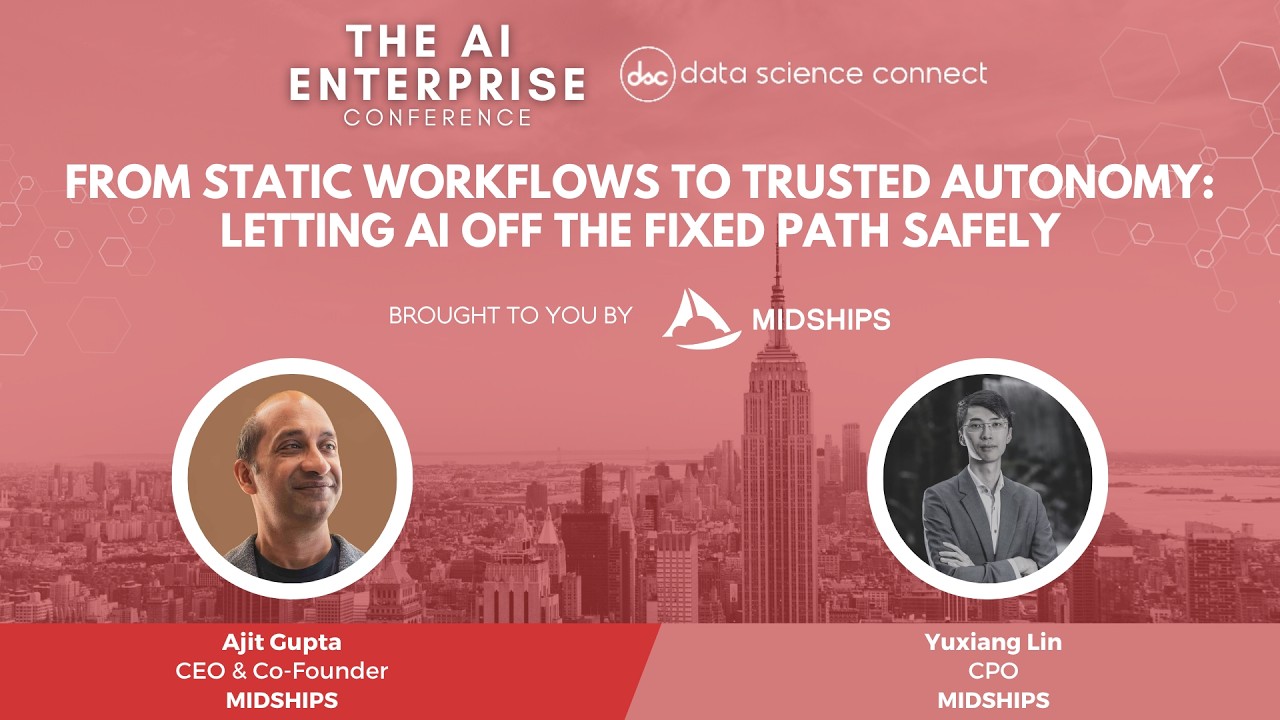
Banks are using AI to rerun fixed chatbot workflows, not to act autonomously, according to Midships CEO Ajit Gupta. At The AI Enterprise Conference 2026, he showed how checking each agent's purpose, objective, plan and API call, with signed human approvals, can keep autonomous agents on track.
Key takeaways
- Banks are stuck in automation. Gupta said most use AI to trigger the same static workflows chatbots ran, not to act autonomously.
- Trust is the barrier. Until companies trust AI to make good decisions, AI spending will deliver limited value, he said.
- IAM covers can, not should. Traditional access controls say what an agent can access, not whether it should right now.
- Hold the humans accountable. Midships ties each agent's actions to the people who set it up, use it and approve it.
- Check every step. Purpose, objective, planned intents and each API call are checked for alignment before the agent proceeds.
Banks are spending heavily on AI, but most are using it to automate the same fixed workflows their chatbots already ran, according to Ajit Gupta, CEO and founder of Singapore-based Midships. At The AI Enterprise Conference 2026 in New York City, Gupta and Midships' Yuxiang Lin showed how the company is trying to let AI agents act on their own in regulated environments without losing control of what they do.
Midships' background is in identity and access management. Gupta said the company has spent the past eight years helping tier-one banks around the world outside the U.S. run identity platforms for their digital services.
Why are banks stuck in AI automation instead of autonomy?
Gupta said that when he asks bank customers about their agentic AI projects, the answer is consistent: they are doing a lot of AI because shareholders and boards demand it, but the work is narrow. "They're using AI, but they're driving automation rather than autonomy," he said.
Most have replaced chatbots with AI that triggers the same static workflows, he said. The experience is better, but a customer whose problem doesn't fit the script still gets passed from person to person. The promise of autonomous AI was different: an agent that understands each customer's problem and builds its own plan to solve it. Gupta said no bank he works with has crossed that bridge.
The reason, he said, is trust. "You don't trust AI to make good decisions," Gupta told the audience, and until that changes, AI spending will deliver limited value.
Why can't identity and access management control AI agents?
Banks have invested in identity and access management, API gateways and LLM platforms. The trouble, Gupta said, is that traditional IAM controls rely on human judgment to hold users accountable, and agents don't have it. He compared holding an agent accountable to holding a five-year-old accountable for every mistake.
"Traditional identity and access management says what you can access," he said. What is missing, according to Gupta, is any control over whether an agent should be accessing something at a given moment.
Midships' answer was to shift accountability to people. An agent can't be held accountable, Gupta said, but "you could hold the human who sets up the AI accountable," along with the person using it day to day.
How do purpose, objective and intent controls work for AI agents?
Midships built a product called Icebreaker that uses context to decide whether an agent should be doing something, Gupta said. It checks four levels:
- Purpose: the reason the agent was set up, such as resolving customer complaints or fraud cases
- Objective: what a user asks it to do. If the objective doesn't fit the purpose, the agent is stopped.
- Intent set: the plan the agent proposes for meeting the objective, which is checked for alignment
- Action: each specific API call. If it matches an approved intent, the agent receives a unique token to perform that action against the MCP server.
While building the product with customers, Gupta said, the team saw agents propose unexpected intents, attempt actions unrelated to an approved intent, and try to reuse an approved token for a different action, all without being manipulated. Icebreaker uses semantic alignment to check each step against the purpose, objective and intent, he said.
What new insider risks does agentic AI create?
Customer service staff are usually limited by the interfaces they work in, which stop them from exporting data or opening many customers' records, Gupta said. Give those same employees an agent with broad access, and those controls fall away. A single prompt could get the agent to do things the user shouldn't.
To address that, Gupta said, Icebreaker can randomly route requests for review. As an example, a company could require supervisor approval for 1% of all generative AI requests. Midships also built the product to run on premises, because its bank customers told Gupta they don't like SaaS. It integrates with existing identity platforms, LLM platforms, API gateways and MCP servers rather than replacing them.
What did the live demo show?
In the demo, the team deliberately poisoned a customer complaint agent so that reading a case would push it to offer the customer a full refund. The user had asked the agent only to analyze the case.
Icebreaker approved the objective, the initial intents and the action to retrieve the case. When the poisoned case led the agent to try to reverse the transaction, those intents were blocked, and the agent finished the analysis it had been asked for. "Every time the agent tried to do the wrong thing, Icebreaker kept it within its rails," Gupta said.
A second run showed human-in-the-loop controls. The user confirmed an action and the approval was cryptographically signed. An out-of-policy step went to a supervisor, who received a summary built from the session's context. Both approvals were recorded in the audit trail, so a rogue action could be traced back to the person who approved it, Gupta said.
Hear more on agentic AI governance in 2027
Sessions on letting AI agents act safely in regulated industries were a recurring theme at The AI Enterprise Conference 2026. The conference returns to Pier Sixty in New York City on Tuesday, August 31, 2027. Data Science Connect's free webinars, including the Agentic AI Showcases series, continue the conversation online between conferences.
Frequently asked questions
What is the difference between AI automation and AI autonomy?
As Gupta described it, automation uses AI to trigger predefined workflows, while autonomy lets an agent understand a problem and build its own plan to solve it.
Why can't identity and access management control AI agents?
Traditional IAM defines what a user can access and relies on human judgment for the rest. Gupta said agents lack that judgment, so a separate control is needed to decide whether an action should happen.
How do you keep an autonomous AI agent from going off track?
Midships checks that a user's objective matches the agent's purpose, that the agent's planned intents match the objective, and that each API call matches an approved intent before issuing a token for it.
What is human attestation for AI agents?
In Midships' demo, a user or supervisor approves a specific agent action, and the approval is cryptographically signed and recorded in the audit trail.
Watch: From Static Workflows to Trusted Autonomy: Letting AI Off the Fixed Path Safely on YouTube
Event: The AI Enterprise Conference · More coverage: The AI Enterprise Conference insights


